Uniform electric fields and field strength
Key ideas
An electric field is a region where a charge feels a force. Between two parallel charged plates the field is uniform — the same strength and direction everywhere — and points from the positive plate to the negative plate.
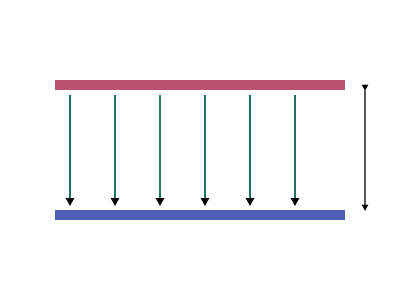
Electric field strength
For a uniform field between plates a distance apart with a voltage across them:
- — electric field strength (V m⁻¹, or equivalently N C⁻¹)
- — voltage (potential difference) between the plates (V)
- — separation of the plates (m)
Force on a charge in the field
Any charge placed in the field feels a force:
- — force on the charge (N)
- — size of the charge (C)
- — field strength (N C⁻¹)
A positive charge is pushed in the direction of the field (toward the negative plate); a negative charge is pushed the opposite way.
:::tip Convert units before substituting. Plate separations are usually given in millimetres and charges in micro- or nanocoulombs. A mm gap is m, and µC is C. Forgetting the powers of ten is the number-one error here. :::
Two parallel plates are mm apart with V across them. Find the field strength, and the force on a µC charge placed between them.
Step 1 — Convert units
Step 2 — Field strength
Step 3 — Force on the charge
Practice question
Two plates mm apart have a field of N C⁻¹ between them. Find the voltage across them.
Worked solution: rearrange → V.
Test yourself
Practice by grade
One question each at Achieved, Merit and Excellence. Have a go, then compare with the model answer.
Two parallel plates are mm apart with a potential difference of V across them.
Calculate the electric field strength between them.
A charge of µC is placed between two parallel plates mm apart with V across them.
Calculate the force on the charge.
Two identical charged plates are held at a fixed voltage. Explain fully what happens to (a) the field strength and (b) the force on a fixed charge between them if the plate separation is doubled.