Series and parallel circuits
Key ideas
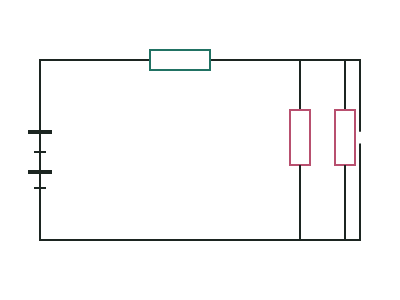
Components can be wired in series (one path) or parallel (branching paths). The standard focuses on parallel circuits with resistor(s) in series with the source — a common real layout.
Series rules
- Same current everywhere: is the same through each component.
- Voltages add up to the supply:
- Resistances add:
Parallel rules
- Same voltage across each branch.
- Currents add: the supply current splits between branches,
- Combined resistance is less than the smallest branch:
:::tip After finding for a parallel section, take the reciprocal to get — the most common slip. And sanity-check: the parallel combination must be smaller than the smallest branch. If you get a value bigger than any branch resistor, you have made an error. :::
A resistor is in series with the battery, then feeds two parallel resistors of and . The supply is V. Find the total resistance and the current drawn from the battery.
Step 1 — Combine the parallel pair
Step 2 — Add the series resistor
Step 3 — Total current from Ohm's law
Practice question
Two resistors, and , are connected in parallel. Find their combined resistance.
Worked solution: , so (half of a single one — equal parallel resistors halve).
Test yourself
Practice by grade
One question each at Achieved, Merit and Excellence. Have a go, then compare with the model answer.
Two resistors, and , are connected in series.
Calculate the total resistance.
A and a resistor are connected in parallel across a V supply.
Calculate the combined resistance and the total current drawn.
In a circuit, a resistor is in series with the battery and feeds two parallel resistors. The supply is V. Calculate the voltage across the parallel section, and explain fully why it is less than the supply voltage.