The forward pass
What the forward pass finds
- The forward pass works left to right through the network to find, for every activity:
- its earliest start time (EST) — the soonest it can begin,
- its earliest finish time (EFT) — the soonest it can be complete.
- These go in the top row of each node box (EST top-left, EFT top-right).
- The pass also gives the minimum project completion time — the EFT of the final activity.
Earliest start and earliest finish
- For each activity:
- EST — earliest start time; the soonest all predecessors are done.
- duration — the fixed length of the activity.
- EFT — earliest finish time; add the duration to the earliest start.
The forward pass rule
- Start activities (no predecessor) have .
- For any other activity, its EST is the earliest finish time of its predecessor:
- Then apply and carry the EFT forward along each arrow.
Merging paths — take the largest
- At a merge point an activity has several predecessors and must wait for all of them.
- Its EST is the largest (latest) of the incoming earliest finish times:
- Taking the smallest by mistake would start the activity before some predecessor is finished — the classic forward-pass error.
The completed forward pass
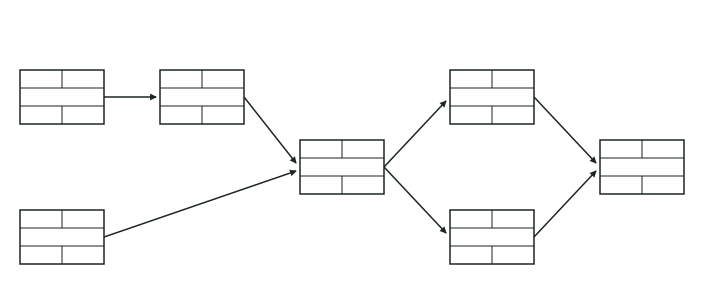
- Reading the top rows of the hall network: A finishes at 3, B at 7, C at 2. D merges B (7) and C (2), so and . E finishes at 15, F at 14. G merges E (15) and F (14), so and .
Carry out the forward pass for the community hall network. Durations: A(3), B(4), C(2), D(5), E(3), F(2), G(4). A→B, C→D, B→D, D→E, D→F, E→G, F→G. Find the minimum project completion time.
Step 1 — Start activities
A and C have no predecessor, so both start at 0:
Step 2 — Follow the arrows forward
B follows A, so and .
Step 3 — Merge at D (take the largest)
D waits for B (EFT 7) and C (EFT 2):
Step 4 — Split to E and F
Both follow D:
Step 5 — Merge at G (take the largest)
G waits for E (15) and F (14):
Test yourself
Practice by grade
One question each at Achieved, Merit and Excellence. Have a go, then compare with the model answer.
An activity has earliest start time 6 and duration 4. Find its earliest finish time, and state the formula you used.
Activity W merges three predecessors with earliest finish times 8, 11 and 9. W has duration 5. Find W's earliest start and earliest finish, and explain the choice you made at the merge.
In the hall network the frame D merges B (EFT 7) and C (EFT 2). Explain why speeding up activity C would not change the project completion time, using the forward-pass merge rule, and state what would need to change to make C matter.