Drawing the activity network
Activity-on-node networks
- An activity network is a diagram that shows how the activities of a project connect.
- In the activity-on-node (AON) convention each activity is drawn as a node box, and arrows show precedence.
- An arrow from box to box means " must finish before can start".
- Time flows left to right: earlier activities sit on the left, later ones on the right.
The parts of a node box
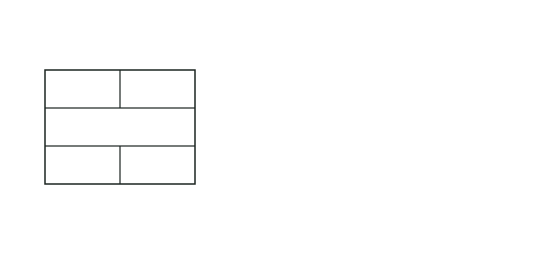
- Each node box is split into compartments:
- Top-left — EST, the earliest start time.
- Top-right — EFT, the earliest finish time.
- Middle band — the activity letter and its duration, e.g. "C (2)".
- Bottom-left — LST, the latest start time.
- Bottom-right — LFT, the latest finish time.
- The top row is filled by the forward pass, the bottom row by the backward pass — for now leave them blank and just draw the structure.
Drawing the network from the table
- Draw one node box for each activity, labelled with its letter and duration.
- Draw an arrow into an activity from each of its immediate predecessors.
- Activities with no predecessor start at the left-hand edge; activities that nothing depends on end at the right-hand edge.
- Keep arrows flowing left to right and avoid crossing them where you can — a tidy network is easier to pass through.
Reading the community hall network
- Drawing the hall's table as a network gives the layout below (top and bottom rows already completed by the passes on the following pages):
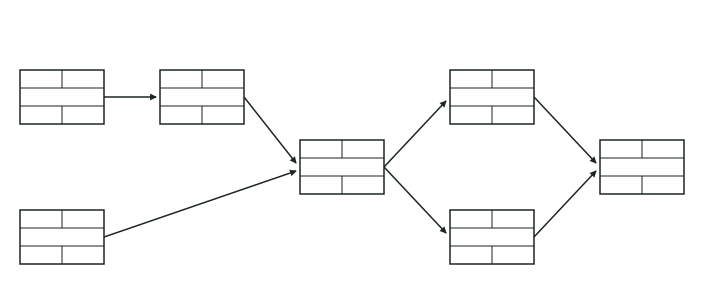
- A and C begin at the left. A feeds B; B and C both feed D; D feeds E and F; E and F both feed G, the final activity.
Draw the activity network (structure only) for this table.
| Activity | Immediate predecessor(s) | Duration |
|---|---|---|
| A | — | 3 |
| B | A | 4 |
| C | — | 2 |
| D | B, C | 5 |
| E | D | 3 |
| F | D | 2 |
| G | E, F | 4 |
Step 1 — Place the starting activities
A and C have no predecessor, so draw their node boxes at the left edge, one above the other.
Step 2 — Add each activity with its incoming arrows
- B follows A: draw an arrow .
- D follows B and C: draw arrows and (D is a merge).
- E and F both follow D: draw arrows and .
- G follows E and F: draw arrows and (G is a merge).
Step 3 — Check the ends
Nothing depends on G, so G sits at the right edge as the final activity.
Test yourself
Practice by grade
One question each at Achieved, Merit and Excellence. Have a go, then compare with the model answer.
In an activity-on-node network, what does an arrow drawn from box X to box Y mean?
A network has activities H, then two parallel activities I and J that both follow H, and K that follows both I and J. Describe how many arrows enter K and why, and identify K as a merge point.
Explain why an activity network for a valid project can never contain a cycle (a loop of arrows returning to where it started), and what a cycle would imply about the precedence table.