Float and the critical path
What float is
- The float (or slack) of an activity is the spare time it has — how long it could be delayed without pushing out the whole project.
- An activity with float can slip, start late, or run over a little and the project still finishes on time.
- An activity with zero float has no spare time — any delay to it delays the entire project.
Calculating float
- Once both passes are done, float comes straight from the node box:
- LST — latest start time (bottom-left). EST — earliest start time (top-left).
- The two forms are equal, so you can use whichever pair is easier — or use one to check the other.
- Float is always zero or positive; a negative float means an arithmetic slip in a pass.
The critical path
- The critical path is the chain of activities from start to finish that all have zero float.
- It is the longest path through the network by total duration — and it sets the project completion time.
- Every project has at least one critical path; there may be more than one if paths tie in length.
- Delaying any critical activity delays the whole project; that is what makes them "critical".
Identifying critical activities
- Work out the float of every activity from .
- Pick out the activities with float — these are the critical activities.
- Join them along the arrows from the first activity to the last: that chain is the critical path.
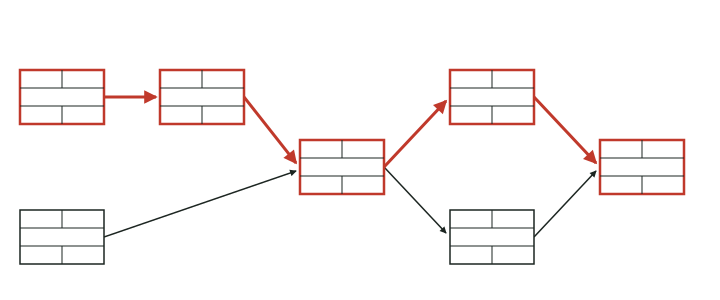
- In the hall build the critical path is , all with float 0. C has float 5 and F has float 1, so both are non-critical — they have room to slip.
Using the completed hall network, build a float table for all seven activities and state the critical path. EST/EFT and LST/LFT are: A 0/3, 0/3; B 3/7, 3/7; C 0/2, 5/7; D 7/12, 7/12; E 12/15, 12/15; F 12/14, 13/15; G 15/19, 15/19.
Step 1 — Apply float = LST − EST to each activity
| Activity | EST | LST | Float (LST − EST) |
|---|---|---|---|
| A | 0 | 0 | 0 |
| B | 3 | 3 | 0 |
| C | 0 | 5 | 5 |
| D | 7 | 7 | 0 |
| E | 12 | 12 | 0 |
| F | 12 | 13 | 1 |
| G | 15 | 15 | 0 |
Step 2 — Pick out the zero-float activities
A, B, D, E and G all have float 0. C (float 5) and F (float 1) are not critical.
Step 3 — Join them into a path
The zero-float activities form the unbroken chain from start to finish:
Test yourself
Practice by grade
One question each at Achieved, Merit and Excellence. Have a go, then compare with the model answer.
An activity has earliest start 12 and latest start 13. Find its float and state whether it is critical.
In the hall build, activity C (order fittings) has float 5. Explain in context what this means for the project manager, and what would happen if C were delayed by 6 days.
Explain why the critical path must always be the longest path through the network, and why every activity on it necessarily has zero float. Use the definitions of the two passes.