What counts as a cultural process
The definition, and how wide it really is
- A cultural process is any process caused by people. That is the standard's whole definition, and nothing narrower is implied.
- The usual choices are urbanisation, tourism, agricultural intensification, migration, resource extraction, deforestation, gentrification and industrialisation — but any human-caused process qualifies.
- The environment may be anywhere. Unlike AS91426, there is no New Zealand requirement, and the standard says environment(s) — so a process operating in more than one place is allowed and sometimes stronger.
- A geographic environment here is the features and characteristics of one or more areas where the process operates. The area has to be big enough to show the process, not the other way round.
- The worked case study on these pages, invented throughout: agricultural intensification — the conversion of dryland sheep country to irrigated dairying — in the Te Rapanui Basin, an invented 1,800 km2 eastern South Island plain.
A process, not an event and not a land use
- A process is a sequence of human actions that changes an environment over time. It has a mechanism, a rate and a direction.
- A land use is not a process. Dairy farming is a land use; conversion to irrigated dairying is a process. The naming box wants the second.
- An event is not a process either. The plant opened in 2003 is an event; it is a trigger inside a process, which is a different and very useful thing.
- Test your choice with a verb. If you can put -ing on it and it describes something still happening — intensifying, urbanising, migrating, gentrifying — it is a process.
- Say who is doing it. Caused by people means there are decision-makers: farmers, councils, iwi, investors, a company, a government. Naming them makes the rest of the answer easier.
Breaking the process into elements
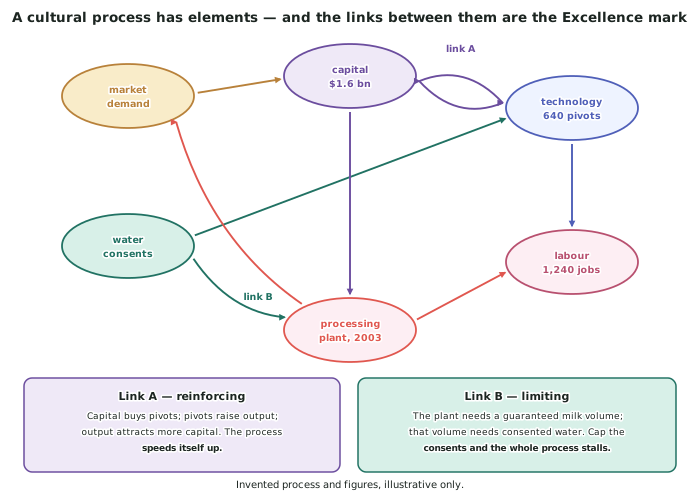
- The standard defines insight as analysis of the links between the elements of the cultural process. So you must be able to say what the elements are.
- The six elements that fit almost any cultural process: the market or demand, the capital, the technology, the rules (law, consents, planning), the labour, and the infrastructure.
- In the invented Te Rapanui case they are: demand for milk powder; about $1.6 billion of investment since 2000; 640 centre-pivot irrigators; the water consents issued by the regional council; 1,240 direct jobs; and the milk processing plant that opened at Kōpuru in 2003.
- List your elements in the first two minutes of the exam. They become the paragraphs of your answer and the annotations on your diagram.
- You cannot analyse links between elements you have not identified. This is the single most common reason strong candidates stall at Merit in this standard.
How the paper is built
- ONE question, no choice, all parts compulsory, exactly as in every other Geography external.
- A titled MAP / DIAGRAM page is supplied and you must construct an annotated map or diagram. This was true in every year checked from 2022 to 2025.
- In 2025 the question split into (a) the drawing and (b) the writing, with the drawing explaining how the process had impacted the environment and the writing explaining how it operates to create impacts on people.
- The naming box comes first: name the cultural process and the geographic environment(s) it shapes.
- The paper prints the insight definition — links between the elements of the cultural process to draw conclusions — in its own bullet list. Treat it as the instruction it literally is.
A second process, so you do not think this standard is about farming
- Tourism works exactly the same way, and the elements map straight across: demand (visitor numbers), capital (hotel investment), technology (booking platforms, air links), rules (concessions, freedom-camping bylaws), labour (seasonal and migrant staff), infrastructure (airport, road, wastewater plant).
- So do urbanisation and gentrification. Demand for housing, mortgage capital, construction methods, zoning rules, construction labour, transport infrastructure.
- The analysis you learn on one process transfers to any other, which is why these pages teach elements and links rather than one case study's facts.
- What does not transfer is the evidence. Learn about twenty figures for your own process, with dates attached.
Worked Example
Worked example
A student is filling in the naming box, which asks for the cultural process and the geographic environment(s) it shapes. Three attempts. Diagnose each, then write the version that sets the answer up.
- Attempt 1: Process: farming. Environment: New Zealand.
- Attempt 2: Process: the 2003 opening of the Kōpuru milk plant. Environment: Kōpuru.
- Attempt 3: Process: dairy farming in the Te Rapanui Basin. Environment: the Te Rapanui Basin.
Answer:
Step 1 — test each "process" with the verb test.
Farming is a land use, not a process — you cannot say the environment is farming-ing. The 2003 opening is a single event with a date; it happened once and stopped, so it has no rate. Dairy farming is a land use again, dressed up with a location. None of the three names a process.
Step 2 — check the environment for scale.
New Zealand is too big to show the process operating and too big to name evidence in. Kōpuru — one town — is too small to show spatial variation. Attempt 3's basin is the right size.
Step 3 — find the process hiding inside each attempt.
Behind all three is the same thing: land is being converted from dryland sheep farming to irrigated dairying, and the conversion is still going on. That is a process: it has a mechanism (irrigation), a rate (hectares per year), and a direction.
Step 4 — write the version that sets the answer up.
Process: agricultural intensification — the conversion of dryland sheep and cropping country to irrigated dairying, running since about 1990 and concentrated between 2003 and 2014.
Environment: the Te Rapanui Basin, about 1,800 km2 of the eastern South Island, bounded by the Whareroa foothills in the west and the coast in the east, with the town of Kōpuru at its centre.
Elements of the process: demand for milk powder; capital, about $1.6 bn invested since 2000; technology, 640 centre-pivot irrigators where there were none in 1990; rules, the regional council's water consents; labour, 1,240 direct jobs; and infrastructure, the Kōpuru milk plant opened in 2003.