Impacts on people
What the standard asks for
- The second aspect is how the process has impacted on people and the environment(s). People come first in the wording and they are usually where the marks are lost.
- An impact is a change in how people live, work, decide or feel that the process caused. It is not the same as a description of the process.
- Sort impacts into economic, social and environmental, because that is the frame the papers use repeatedly at Level 3.
- Every impact needs a group, a direction and a figure. Who was affected, how they were affected, and by how much.
- Impacts are not all positive or all negative, and an answer that runs in only one direction reads as an argument rather than an analysis.
Economic impacts
- Name the people, not the sector. The economy grew is worth nothing; 210 farms, 1,240 direct jobs, and a processing plant employing 380 people is evidence.
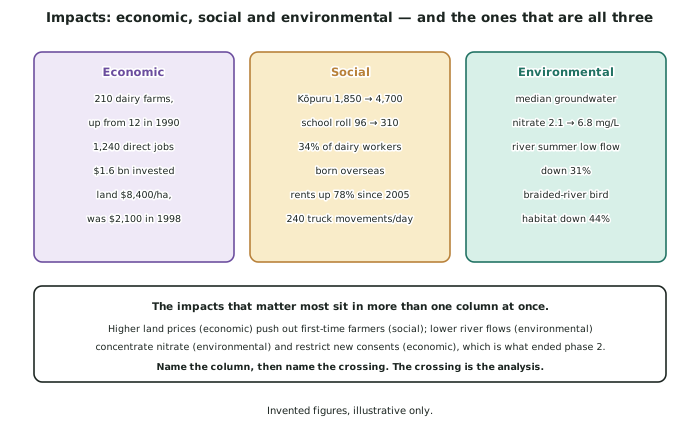
- In the invented Te Rapanui Basin: dairy farms rose from 12 in 1990 to 210 in 2024; about $1.6 bn has been invested since 2000; land prices rose from about $2,100/ha in 1998 to $8,400/ha in 2024.
- Say who gained and who lost from the same figure. Rising land value rewards the farmer who converted in 2004 and shuts out the first-time buyer in 2024. One number, two groups, opposite effects.
- Follow the money out of the district as well as into it. Corporate ownership means some of the return leaves the basin, and saying so is more precise than saying the district got richer.
- Include the costs that fall on the public. Road maintenance for 240 truck movements a day is paid for by ratepayers, not by the process.
Social impacts
- Population change is the easiest to evidence. Kōpuru grew from 1,850 people in 1996 to 4,700 in 2023, and the school roll from 96 to 310.
- Composition matters as much as size. 34 per cent of dairy workers in the basin were born overseas, which changes the languages spoken, the services needed and the school's staffing.
- Housing is where the economics land on people. Rents in the basin rose about 78 per cent between 2005 and 2024, which affects workers who are not landowners.
- Name the losses as well as the gains. Fewer, larger farms mean fewer farming families, and a district with 210 large farms supports different community institutions from one with 600 small ones.
- Include effects on Māori as a distinct group where they apply, and be specific: in the invented case, mana whenua concern focuses on the Rapanui River and the loss of mahinga kai, not on farming in general.
Environmental impacts
- Environmental impacts belong here too, because the standard says people and the environment(s).
- In the invented basin: median groundwater nitrate rose from 2.1 mg/L in 1995 to 6.8 mg/L in 2023; summer low flows in the Rapanui River fell by about 31 per cent; braided-river bird habitat fell by about 44 per cent.
- Give the mechanism, not just the number. Nitrate rises because more nitrogen is applied and more urine is deposited on free-draining soils than the pasture can take up, and the surplus leaches to groundwater.
- Environmental impacts become social ones. A shallow bore that no longer meets the drinking-water standard is an environmental measurement and a household's problem.
- Say where the impact is, not just that it exists. Nitrate is highest where the aquifer is shallowest, which is not the same place as the highest stocking rate.
The move that lifts the grade: crossings
- The impacts worth writing about sit in more than one column at once.
- Higher land prices are economic; they push out first-time farmers, which is social; they encourage higher stocking to service the debt, which is environmental.
- Lower river flows are environmental; they concentrate nitrate, which is environmental again; they triggered the 2017 consent cap, which is economic and which stopped the process.
- Name the column, then name the crossing. The crossing is the analysis, and it is what the standard's links between the elements wording is pointing at.
- A crossing that comes back round to the process itself is the strongest of all — an impact that changes the process that caused it.
Worked Example
Worked example
Explain how a cultural process you have studied has impacted on people.
Answer:
Step 1 — choose one impact and identify the group it lands on.
The impact is the rise in land prices, from about $2,100/ha in 1998 to $8,400/ha in 2024 in the invented Te Rapanui Basin. The groups affected are (a) landowners who converted early, (b) people trying to buy their first farm, and (c) farm workers who rent.
Step 2 — explain the mechanism, not just the number.
Land price follows the income the land can produce. Once irrigation raised production per hectare, the same paddock could service far more debt, so buyers could bid more for it. The price rose because the land's earning capacity rose, not because more people wanted to live there.
Step 3 — take each group in turn and say what actually changed for them.
- Early converters gained a windfall on an asset they already owned, which let them borrow against it and buy more land — which is part of why the number of dairy farms is 210 rather than several hundred.
- First-time buyers were shut out. A young farmer who could have bought 80 ha for about $170,000 in 1998 would need about $670,000 for the same block in 2024, at a time when their wages rose far less.
- Renting workers were hit twice: they cannot buy in, and rents rose about 78 per cent between 2005 and 2024 as the population of Kōpuru grew from 1,850 to 4,700.
Step 4 — cross the columns.
The same rise has an environmental consequence. A farm bought at $8,400/ha carries debt that has to be serviced, and the reliable way to service it is to stock more heavily and apply more nitrogen. So an economic impact on one group becomes a pressure on the aquifer that everyone in the basin drinks from.
Step 5 — close the loop back to the process.
That pressure is part of what raised median groundwater nitrate from 2.1 to 6.8 mg/L, which is part of what persuaded the council to cap new consents in 2017 — the decision that stopped the process. The impact of the process eventually became the limit on the process.