The drawn answer, and the grade ladder
What has to go on the MAP / DIAGRAM page
- A titled MAP / DIAGRAM page is supplied and you must construct an annotated map or diagram. This was required in every paper checked from 2022 to 2025, and became part (a) in 2025.
- In 2025 the drawing had to explain how the process had impacted the environment, while part (b) explained how the process operates to create impacts on people.
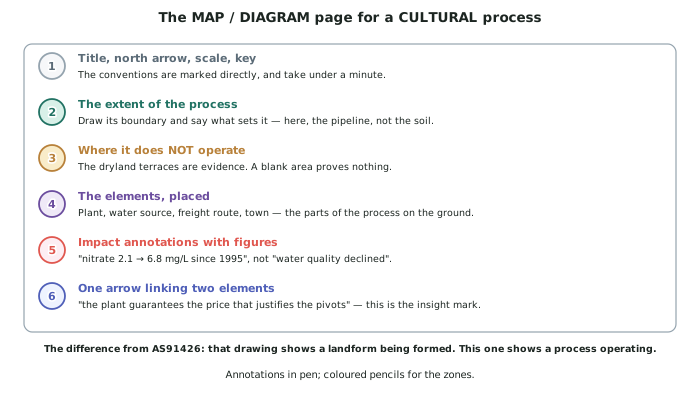
- The difference from AS91426 is what the drawing shows. There, a drawing shows a landform being formed. Here it shows a process operating: where it works, where it does not, what it needs, and what it has changed.
- Draw the boundary of the process and say what sets it. In the invented Te Rapanui case that is the pipeline, and the annotation should say so.
- Include the area the process did not reach. It is evidence, and a blank corner of the page is not.
Annotations that earn marks here
- Place the elements on the ground. The plant, the water source, the freight route, the town. A cultural process has infrastructure, and infrastructure has a location.
- Annotate impacts with figures. Median groundwater nitrate 2.1 → 6.8 mg/L since 1995 beats water quality has declined by several marks and by three words.
- Annotate the boundary with its cause. Edge of the command area — the limit of consented water, not of suitable soil.
- Add one arrow linking two elements, with a sentence on it: the plant guarantees the price that justifies the pivots. This is the insight mark in visual form.
- Conventions still count: title, north arrow, scale, key. Under a minute for all four, and they are marked directly.
The grade ladder, in the standard's own words
- Achieved: demonstrate understanding of how the cultural process shapes the environment(s), with supporting case study evidence.
- Merit: in-depth understanding — explained in detail, with detailed evidence.
- Excellence: comprehensive understanding — an insightful analysis, with integrated comprehensive evidence.
- Insight is defined as analysis of the links between the elements of the cultural process to draw conclusions, and the paper prints that sentence in the question.
- Integrating is defined as relevant examples woven throughout the evidence. Facts in their own paragraph are not integrated, however good they are.
Turning Merit into Excellence, concretely
- Merit is a well-evidenced account of how the process operates and what it has done. Most candidates who prepare a case study can reach it.
- Excellence requires a link between two elements and a conclusion drawn from it. In the invented case there are two obvious candidates:
- the reinforcing link — capital and technology raise land value, which finances the next conversion, so the process accelerates itself
- the limiting link — the plant needs guaranteed volume, which needs consented water, so capping consents stops everything
- State the conclusion explicitly. A process with a reinforcing loop and a regulatory gate produces an S-shaped history is a conclusion; the elements are all connected is not.
- Then test it. Say what should be true if your conclusion is right, and check it against your evidence. That single move is what markers call insight.
A time plan for the whole paper
- Naming box, with elements and figures. Two minutes, and it seeds everything else.
- The MAP / DIAGRAM page. Ten minutes: outline, features, conventions, five annotations, one linking arrow.
- Spatial variation paragraph — boundary, both sides, cause, consequence.
- Temporal variation paragraph — phases, rates, turning points, decisions.
- Impacts paragraphs — economic, social, environmental, with at least one crossing.
- The links-and-conclusion paragraph, written while you still have time to do it properly.
- Check the naming box matches what you wrote. Every year some answers name one process and analyse another.
Worked Example
Worked example
Analyse how the operation of a cultural process you have studied has created impacts on people. Support your answer with comprehensive evidence, integrated throughout.
Below is the same paragraph at Merit and at Excellence, so the difference is visible.
Answer:
The Merit version.
Intensification in the Te Rapanui Basin has affected people in several ways. 1,240 direct jobs have been created, 380 of them at the Kōpuru milk plant, and the town's population has grown from 1,850 in 1996 to 4,700 in 2023, with the school roll rising from 96 to 310. 34 per cent of dairy workers were born overseas. At the same time rents have risen about 78 per cent since 2005, land prices have risen from $2,100/ha to $8,400/ha, and the freight route now carries 240 truck movements a day.
Why it is Merit. Every claim is specific, quantified and correct. The impacts are named on both sides. What is missing is any link between them — the paragraph is a well-evidenced list.
The Excellence version.
The impacts of intensification on people in the Te Rapanui Basin are best understood as one mechanism producing what look like two opposite outcomes. Conversion raises what a hectare can earn, which raises what it is worth — from $2,100/ha in 1998 to $8,400/ha in 2024 — and that single change does all the work.
On one side it creates the demand for labour that gave the district 1,240 direct jobs, 380 of them at the Kōpuru plant, took the town from 1,850 people to 4,700, and lifted a school roll from 96 to 310 in a district that had been closing classrooms. Because the local population could not fill those jobs, 34 per cent of dairy workers were born overseas, and the town now supports services it did not have in 1990.
On the other side, the same land-value rise converts those workers into permanent tenants. It is what put a first farm out of reach — an 80 ha block that cost about $170,000 in 1998 would cost about $670,000 now — and it is what pushed rents up about 78 per cent since 2005, because the people the process brought in must all be housed on land the process made expensive.
So the benefit and the cost are not a trade-off between two groups; they are the same event arriving at people in different positions. Whether the process made you better off in this basin depended almost entirely on whether you owned land inside the command area before 2001 — a fact about the past, not about anything anyone did afterwards. That is why the district's gratitude and its resentment have proved so durable: both are correct.