What makes a topic global
The definition that decides your topic
- Global means regions or nations across different continents or hemispheres. The standard says so in those words, and it is the test most rejected topics fail.
- "Big" is not the same as "global". Drought across Australia is enormous and it is one continent. Migration across the European Union covers many nations on one continent. Neither is global under this definition.
- Two ways to satisfy it: the topic occurs on several continents, or it occurs in both hemispheres. Either is enough, and a strong topic usually does both.
- A topic in one country with global causes is still not global. Why New Zealand imports oil has worldwide causes, but the pattern being described sits in one country.
Natural topics and cultural topics both qualify
- The standard says a natural and/or cultural topic. Both are allowed, and neither is worth more.
- Natural topics with clear global patterns: earthquake and volcanic activity, tropical cyclones, desertification, coral reef distribution, biomes.
- Cultural topics with clear global patterns: international migration, tourism flows, the distribution of megacities, global trade routes, food production and hunger.
- The test is the same either way: can you state the pattern in one sentence, and could someone check it on a map? If the answer to either is no, the topic is not ready.
The worked topic: where earthquakes and volcanoes are
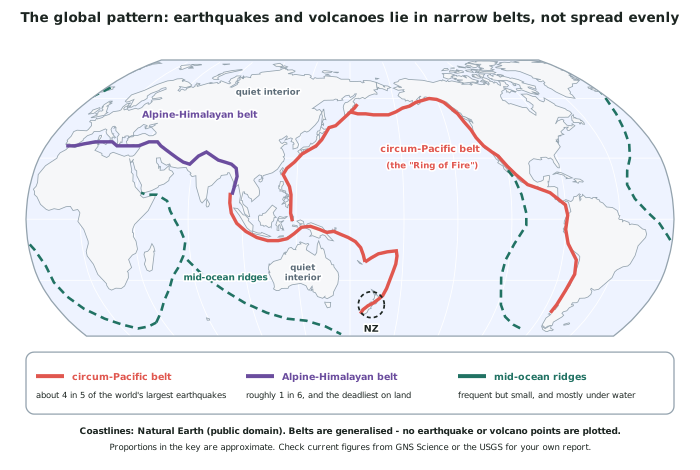
- Why this topic passes the global test easily. The belts cross every inhabited continent and both hemispheres, and the pattern is the same kind of thing in Chile, Japan, Italy and New Zealand.
- Why it is a good topic to learn the standard on. The pattern is stable — it is not a statistic that changes every year — so the description does not go out of date, and the causes are a genuine sequence of events rather than a list of conditions.
- The pattern in one sentence: earthquakes and volcanoes are not spread evenly across the Earth's surface but concentrated in narrow, mostly linear belts, the largest of which runs around the entire rim of the Pacific Ocean.
- The figures, and how to treat them. Published summaries from agencies such as the USGS put roughly four out of five of the world's largest earthquakes in the circum-Pacific belt and roughly one in six in the Alpine-Himalayan belt. These are rounded and approximate. Check current figures from a named source for your own report.
Choosing between a stable topic and a changing one
- A stable pattern — plate boundaries, biomes, ocean currents — lets you spend your effort on the explanation, which is where two of the three parts live.
- A changing pattern — migration, tourism, food prices — is more interesting but carries a research cost: every figure needs a date, and figures more than two or three years old will be challenged.
- If you choose a changing topic, choose your source before your topic. Find the agency that publishes the data annually, then build the topic on what it actually measures.
- Either way, never quote a figure without its year. A global figure with no date cannot be compared with anything, and comparison is what a pattern is made of.
What your submission has to contain
- Part 1 — describe the pattern. Where it is, where it is not, and how the intensity varies.
- Part 2 — explain the factors and/or processes. Why it is there and not elsewhere.
- Part 3 — explain the significance for people. What it means for the people who live with it.
- A map is effectively compulsory. The standard does not name one, but a global pattern that is only described in words is very hard to describe in detail, which is the Merit criterion. Draw a sketch map, label the belts or regions, and refer to it in the text.
Worked Example
Worked example
Four students propose topics for AS91246. Decide which meet the standard's definition of global, and fix the ones that do not.
- A: Volcanoes in New Zealand.
- B: The distribution of the world's megacities.
- C: Drought in Australia.
- D: Climate change.
Answer:
Step 1 — apply the definition: regions or nations across different continents or hemispheres.
A fails on scale. One country is not several continents. Fix it by widening to the phenomenon: the global distribution of volcanic activity, with New Zealand as one detailed example inside it. The topic is now global and the local knowledge is still usable.
B passes. Megacities occur in Asia, Africa, South America, North America and Europe, in both hemispheres. Accept — and note that the pattern is a strong one, because it is uneven in a way that can be stated and checked.
C fails on the same test as A. Australia is one continent. Fix it by widening to the global pattern of drought and desertification, comparing the Sahel, central Australia, south-western North America and northern China — several continents, both hemispheres.
D fails a different test. It is unquestionably global, but it is not a pattern. Climate change names no arrangement, so there is nothing to describe in part 1 and no map that could show it. Fix it by naming the arrangement you will describe: the global pattern of sea-level rise exposure, or the global distribution of glacier retreat. Both are checkable; the parent topic is not.
Step 2 — check each fixed topic against parts 2 and 3.
Fixed A has a clear process (plate movement) and clear significance (hazard exposure). Fixed C has factors (latitude, pressure belts, land use) and processes (the sequence from vegetation loss to soil loss). B has both as well. All three would work; D would only have worked once it was narrowed to something that could be mapped.