Explaining the factors and processes
Factors and processes are two different things
- The standard defines both, and it defines them differently. A factor is a circumstance that contributes to the pattern. A process is a sequence of events.
- A factor is a condition. A process is a story. The land is steep is a factor. Rain saturates the soil, weight increases, friction is exceeded, the slope fails is a process.
- The standard says "and/or", so one is enough — but knowing which you are offering keeps the explanation honest. Most global patterns with sharp edges are caused by processes; most patterns with gradual variation are caused by factors.
- A common failure is offering a factor that is really a restatement of the pattern. Some places are more tectonically active than others explains nothing: it is the pattern with the word because in front of it.
The process behind the belts
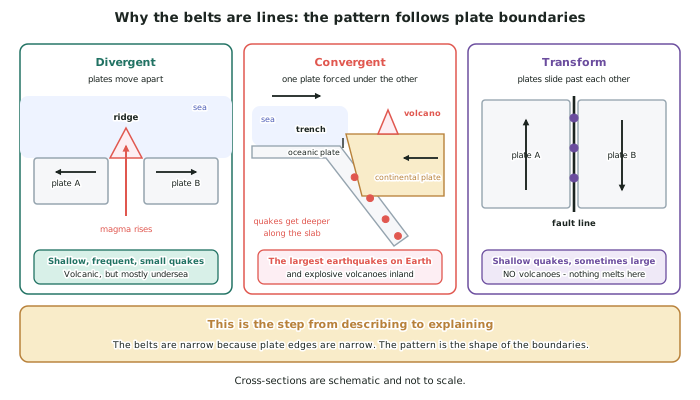
- The Earth's outer shell is broken into a number of rigid plates that move slowly relative to one another — at rates of the order of centimetres per year, comparable to fingernail growth.
- Almost nothing happens in the middle of a plate. The plate moves as one piece, so there is little relative movement inside it. That single fact explains the absences — the quiet interiors of Australia, Siberia, Canada and Brazil.
- Everything happens at the edges, because that is where two plates are in relative motion. The belts are narrow because plate edges are narrow. This is the whole explanation of the pattern's shape, and it is worth saying in exactly those words.
- Three kinds of edge produce three different signatures, which is why the belts are not all alike:
- Divergent — plates move apart, magma rises to fill the gap, new ocean floor forms. Shallow, frequent, small earthquakes; effusive volcanism; mostly under water. This is the mid-ocean ridges.
- Convergent — one plate is forced beneath another. A trench forms at the surface; earthquakes occur along the descending slab and get deeper inland; water carried down lowers the melting point of the rock above, producing explosive volcanoes. This is most of the circum-Pacific belt, and it produces the largest earthquakes on Earth.
- Transform — plates slide past one another. Shallow earthquakes, sometimes very large; no volcanoes, because nothing melts. The Alpine Fault in the South Island is one.
Why the signatures matter for your description
- The belt-by-belt differences you described in part 1 are now explained by the boundary type. That link between the two parts is worth making explicitly.
- The mid-ocean ridges are quiet in human terms because they are divergent and underwater — not because less is happening.
- The Himalayan section of the Alpine-Himalayan belt has few volcanoes because it is a continent-continent collision: neither plate is dense enough to descend far, so there is no subduction to generate melt. The earthquakes are large and shallow, which is why they are so destructive.
- New Zealand contains two boundary types, which is why the North Island has an active volcanic zone and the South Island's largest fault has none.
The exceptions, explained
- Hawai`i and Yellowstone sit in plate interiors, so the boundary explanation cannot account for them.
- The accepted explanation is a hotspot — a persistent source of rising heat beneath the plate. The plate moves over it, so the volcanism stays roughly still while the plate slides past.
- The evidence for this is a pattern within the exception. The Hawaiian islands form a chain that gets older to the north-west, which is what a fixed source under a moving plate would produce, and is not what a moving source would produce.
- Explaining the exception properly is a strong Excellence move, because it shows the main explanation and the exception are consistent rather than in conflict.
What makes an explanation rather than a description
- An explanation answers "why here and not there". If your paragraph would be equally true of a place with no activity, it is not explaining.
- Test each sentence: does it name a mechanism — something moving, melting, breaking, descending? If not, it is a restatement.
- Link the mechanism to the shape. Plates are rigid and move as one piece, so relative motion is concentrated at their edges; edges are long and narrow; therefore the activity is long and narrow. That chain of reasoning is the explanation.
- Say what would falsify it. If large earthquakes were common in the middle of Australia, the plate model could not be right. Naming the test is what separates an explanation from a story.
Worked Example
Worked example
Explain why the earthquake and volcano belts are narrow and linear rather than broad and diffuse — and why the interiors of continents are quiet. Your explanation must contain a mechanism, and must state what would falsify it.
Answer:
Step 1 — identify what actually has to be explained. Not why there are earthquakes, but why the pattern has this shape: narrow, linear, sharp-edged, at the rims of ocean basins, and indifferent to latitude, altitude and the land-sea divide.
Step 2 — name the mechanism.
The Earth's outer shell is divided into rigid plates in slow relative motion, at the order of centimetres per year.
Step 3 — derive the shape from the mechanism, step by step.
- A plate is rigid, so it moves as a single piece. Two points in the middle of one plate barely move relative to each other, so there is little to release as an earthquake.
- Relative motion is therefore concentrated where two plates meet, which is a line, not an area.
- Stress builds where materials in contact move relative to one another, so the release is concentrated along that line.
- Therefore the activity is linear, narrow, and sharp-edged — because the boundary is.
- And therefore plate interiors are quiet — Australia, Siberia, the Canadian Shield, Brazil — because they contain no boundary.
Step 4 — explain why the belts are not all alike, using the three boundary types.
At divergent boundaries the plates separate, pressure on the mantle beneath falls, and it melts to fill the gap: small shallow earthquakes and effusive volcanism, mostly underwater. At convergent boundaries one plate descends beneath the other: a trench at the surface, earthquakes deepening along the descending slab, and — because water driven off the slab lowers the melting point of the mantle above it — explosive volcanoes inland. At transform boundaries the plates slide past one another: shallow earthquakes, sometimes very large, and no volcanoes, because nothing melts.
Step 5 — account for the exceptions.
Hawai`i is thousands of kilometres from a boundary. The accepted explanation is a hotspot: a persistent source of rising heat below a moving plate. The evidence is internal to the exception — the island chain gets progressively older to the north-west, exactly as a fixed source under a moving plate would produce.
Step 6 — state what would falsify it.
If large earthquakes were as common in central Australia as along the Andes, the rigid-plate model could not be right. If Hawaiian island ages were random rather than sequential along the chain, the hotspot explanation would fail. Both tests are available and both are passed, which is why this explanation is held rather than merely proposed.