Explaining the significance for people
The part most submissions run out on
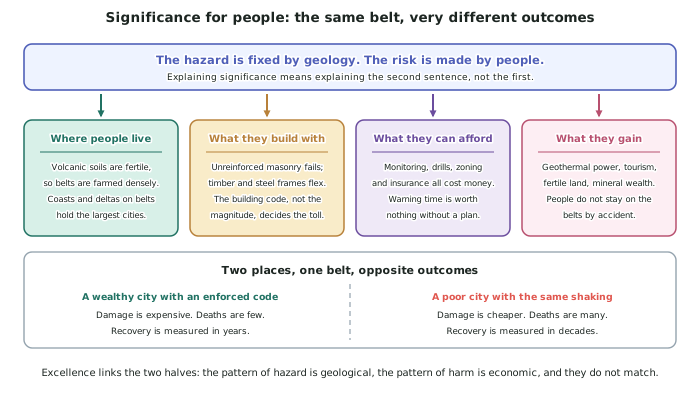
- Significance for people is a third of this standard, and it is where Excellence is decided. Students who describe and explain well often write four general sentences here and stop at Merit.
- Significance is not the same as "effects". A list of what happens to people is a start; significance is why it matters, to whom, and how much.
- Say who. People are affected is not a claim. Roughly 800 million people are estimated to live within 100 km of a volcano that has been active in the recent geological past is — and it is approximate, and must be re-checked from a named source.
- Significance can be positive. Belts are not only hazards: volcanic soils are among the most fertile on Earth, geothermal energy comes from the same process, and people do not live on plate boundaries by accident.
Four strands that work for any global topic
- Where people live. Does the pattern coincide with population, or avoid it? Volcanic soils are fertile and coastal plains beside subduction zones are flat and well-watered, so the belts are settled densely — Java, Japan, central America, the Philippines, and New Zealand's own volcanic plateau.
- What people can do about it. Building codes, land-use zoning, warning systems, drills, insurance. These are the variables that differ between countries facing identical geology.
- What it costs, and who bears it. Loss of life, loss of property, loss of livelihood — and the three do not fall on the same people. Wealthier countries lose more money and fewer lives; poorer countries lose less money and more lives.
- What people gain. Fertile soil, geothermal power, minerals, tourism, harbours. The gains are why the exposure persists, and a submission that leaves them out cannot explain why nobody moves.
The one idea that makes this section work
- Hazard is fixed by geology. Risk is made by people. The shaking is set by the plate boundary; the death toll is set by what was built, where, to what standard, and who could afford to prepare.
- The evidence for this is that similar-sized events produce wildly different tolls, and the difference tracks income, building stock and enforcement rather than magnitude.
- This is the sentence that turns effects into significance, because it explains why the significance of the same pattern differs so much from place to place.
- It also tells you what can be changed. Nobody can move a plate boundary. Almost everything else on the list is a decision.
New Zealand's own position in the pattern
- New Zealand sits on the Pacific-Australian boundary, and the boundary changes type along the country — subduction east of the North Island, transform movement along the Alpine Fault in the South Island.
- GNS Science locates on the order of 20,000 earthquakes in and around New Zealand each year, of which only a small fraction are felt. Approximate — check the current figure from GNS Science.
- The gains are visible too: geothermal generation from the central North Island supplies a substantial share of national electricity, the volcanic plateau's soils support intensive farming, and the same landscape carries a large tourism industry.
- Using your own country as the detailed example inside a global topic is legitimate and usually strong, provided the pattern being described stays global.
Writing significance so it earns Excellence
- Insight, in Geography's own definition, is drawing a conclusion about how things link. Here the link to draw is between the physical pattern and the human pattern, and the conclusion is that they do not match.
- The move that reaches it: show two places on the same belt with different outcomes, and account for the difference without appealing to the geology, which is held constant.
- Avoid the two failure modes. It is very significant because many people are affected has no mechanism. In 2011 the Christchurch earthquake caused... has drifted into a case study of one event.
- Keep the scale global. Individual events are examples inside the argument, not the argument.
Worked Example
Worked example
A student writes this for part 3:
Rewrite it so it would meet Excellence.
Answer:
Step 1 — diagnose. Everything here is an effect, and every clause would be equally true of any hazard anywhere. Nothing explains why the significance differs from place to place, which is what makes it geographic rather than general.
Step 2 — establish the exposure, with a figure.
The belts are densely settled, not empty: published estimates of the Smithsonian and UN type put on the order of several hundred million people — commonly quoted as around 800 million — within about 100 km of a volcano active in the recent geological past. (Approximate; check a current source and note its definition of "active".)
Step 3 — ask why, and answer it with the benefits. Because the same process that produces the hazard produces fertile volcanic soils, geothermal energy, minerals and harbours. Java, Japan and central America are not densely settled in spite of the geology; they are densely settled partly because of it.
Step 4 — make the key move: hold the geology constant and vary the people.
Two cities on the same belt experience comparable shaking. In the wealthier one with an enforced modern building code, the losses are large in money and small in lives, and recovery takes years. In the poorer one, the losses are smaller in money and far larger in lives, and recovery takes decades. The geology is identical. Everything that differs is a human decision or a human constraint.
Step 5 — draw the link, which is the insight.
The map of the hazard is geological, and the map of the harm is economic, and they are not the same map. The belts are set by plate boundaries; the death toll is set by building stock, enforcement, warning systems and what a household can afford to prepare.
Step 6 — say what follows.
Because the harm map is human, it is the one that can be changed. Nobody can move a plate boundary, and every other variable in the list is a decision — which is why the significance of this pattern is, in the end, a question about resources rather than about geology.
The rewrite: