How one viewpoint changed over time
The part with no substitute
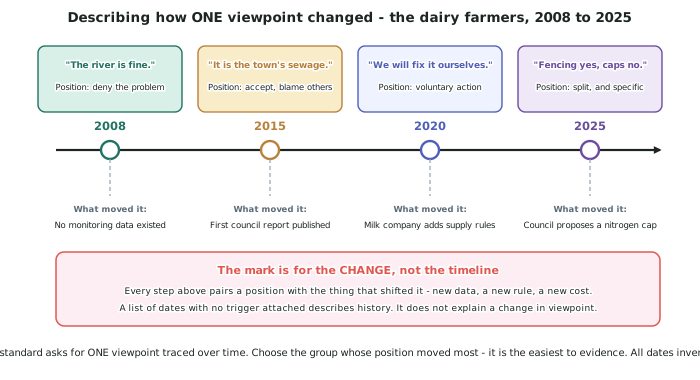
- The standard asks you to describe how ONE viewpoint has changed over time. One group, traced. Not all of them, and not the issue's history.
- This is the part students most often leave out or hand in as a timeline of events, and it is the part with no way to bluff it: either you can show a position moving or you cannot.
- Achieved describes the change. Merit explains it. Describing is the farmers said X in 2008 and Y in 2025. Explaining is and here is what moved them.
- A change needs three things at each step: a date, a position, and a trigger. A date with no trigger is a chronology. A trigger with no position is an event.
Choosing which viewpoint to trace
- Choose the group whose position moved most, because there is more to describe and more to explain.
- Choose a group whose positions are documented — submissions, public statements, newsletters, minutes, local news coverage. A group whose views live only in people's memories cannot be evidenced.
- Do not choose your own group or yourself. Your own change of mind is not a group's viewpoint, and it is not evidence.
- Check the span before you commit. A change over eighteen months is usually a reaction; a change over fifteen years is a shift, and shifts are what the standard is after.
What counts as a trigger
- New information. The first monitoring report; a new measurement; a study.
- A new rule or a new cost. A regional plan change; a national bottom line; a processor's supply conditions.
- An event. A fish kill, a flood, a closure, a health warning — something that made the abstract visible.
- A change in who speaks for the group. New leadership frequently means a new stated position, and it is a legitimate trigger.
- Pressure from a group they depend on. In the invented Ōhaupara case, the milk company's supply rules moved the farmers faster than the council's monitoring did, because the milk company controls whether the milk is collected.
The invented worked change: the dairy farmers, 2008 to 2025
- 2008 — "The river is fine." No monitoring data existed for the catchment, and the position rested on that absence.
- Trigger: the regional council published its first monitoring report in 2015, showing the S1-to-S3 rise.
- 2015 — "It is the town's sewage." The position moved from denying the problem to accepting it and locating the cause elsewhere. This is a real shift, not a dodge, and it should be described as one.
- Trigger: the wastewater discharge point was shown to be below S3, so it could not explain the S2-to-S3 rise; and in 2018 the milk company added riparian fencing to its supply conditions.
- 2020 — "We will fix it ourselves." Voluntary action, on the group's own terms. By 2024, 89 of the 118 farms had fenced their main waterways.
- Trigger: the council's draft plan change in 2026 proposed a nitrogen cap per hectare.
- 2025 — "Fencing yes, caps no." The position is now specific rather than general: it accepts one instrument and rejects another, and it argues about who pays rather than about whether there is a problem.
Describing the change, and then explaining it
- The description is the four positions and their dates. Write them as the group would state them.
- The explanation is what each trigger did to the group's reasoning, and it is where Merit lives.
- Worked: The 2015 report moved the farmers from denial to displacement because it made the decline undeniable but did not identify a source, so the least costly position consistent with the new evidence was to accept the decline and attribute it elsewhere.
- Name the direction of travel. Over seventeen years this group moved from denying the problem to arguing about the instrument. That is a large shift, and saying so is part of describing it.
- Do not present the change as a group becoming enlightened. It is a group responding to information, cost and pressure. That reading is both more accurate and more useful for part 5, because it tells you what would move them next.
Worked Example
Worked example
A student has this for part 3:
Rewrite it so it describes and explains a change in viewpoint.
Answer:
Step 1 — diagnose. Three events and one unevidenced conclusion. No position is stated at any date, so no change is described. This would not meet Achieved.
Step 2 — attach a position to each date. What would a farmer in the catchment have said about the river in that year?
- 2008: the river is fine — and note the reason this was tenable: no monitoring data existed.
- 2015: the decline is real, but it is the town's sewage.
- 2020: it is partly us, and we will fix it ourselves.
- 2025: fencing yes, a per-hectare cap no.
Step 3 — attach the trigger that moved each position, and say what it did.
The 2015 report made denial untenable but did not name a source, so the group accepted the decline and attributed it elsewhere — the least costly position consistent with the new evidence.
The discharge point being below S3 removed the sewage explanation, and the 2018 supply conditions attached a commercial cost to inaction. Together these moved the group from displacement to voluntary action, and note which one bit harder: the milk company decided whether the milk was collected, so it moved the group faster than the regulator did.
The 2026 draft plan change turned an open question into a specific instrument, and the position narrowed accordingly — from a general stance to accepting one measure and rejecting another.
Step 4 — name the direction and what would move it next.
Over seventeen years the group moved from denying the problem to arguing about the instrument and who pays for it. The pattern in the triggers is that commercial cost moved them faster than evidence did, which suggests the next shift would come from a change in what the milk company or the banks require, rather than from further monitoring.
The rewrite: