Courses of action, and justifying a recommendation
What a course of action is
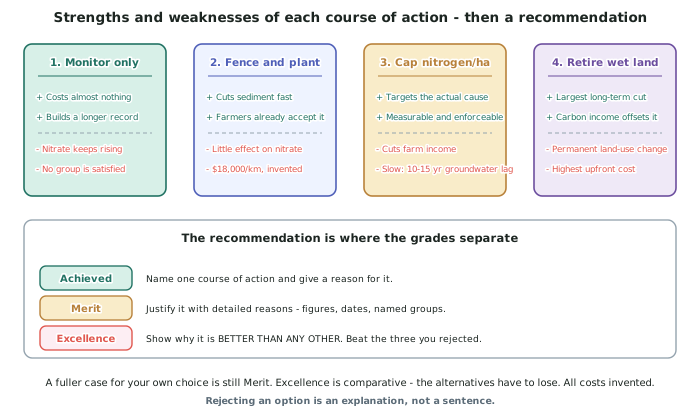
- A course of action is a specific thing somebody would actually do, with someone named to do it. Raise awareness is not one. The regional council requires riparian fencing on all permanently flowing waterways within five years is.
- The standard asks for the strengths and weaknesses of different courses of action — plural, and both halves for each one.
- Include doing nothing. Continue monitoring and change no rules is a real option that real councils choose, it has genuine strengths, and a submission that omits it has skipped the option its recommendation most needs to beat.
- Three or four options is right. Two is not enough to show a comparison; six means none of them gets analysed.
The four invented options for the Ōhaupara catchment
- Option 1 — monitor only. Keep sampling, change no rules. Cost about $45,000 a year.
- Strengths: almost no cost; builds a longer record, which matters given the lag; no group is forced into anything.
- Weaknesses: the readings keep rising; it satisfies nobody; and it uses up years the recovery will need.
- Option 2 — fence and plant the riparian margins. About 310 km of waterway at about $18,000 per km, so roughly $5.6 million.
- Strengths: cuts sediment and E. coli quickly, within two or three years; the farmers already accept it, so it would actually happen; it is visible, which matters to the residents.
- Weaknesses: little effect on nitrate, which is the measure the 2035 limit is written in; the cost falls on farms; the planting takes years to shade and stabilise.
- Option 3 — cap nitrogen per hectare. Modelled at about $310 per hectare per year.
- Strengths: it targets the actual mechanism; it is measurable and enforceable; it is the only option the council models as reaching the 2035 limit.
- Weaknesses: it cuts farm income; the 10 to 15 year lag means no visible result for a decade; and it is the option most likely to be litigated.
- Option 4 — retire the wettest land to forestry and wetland. About 8 per cent of the flats.
- Strengths: the largest long-term nitrate reduction; carbon income partly offsets it; wetlands also trap sediment.
- Weaknesses: the highest upfront cost; a permanent land-use change; and it removes productive land from a district whose economy runs on it.
Strengths and weaknesses: doing it properly
- Every option needs both. An option with only strengths listed is the one you have already decided on, and a marker will read it that way.
- Weigh against stated criteria, and say what they are. Effectiveness against nitrate; speed; cost, and who bears it; acceptability to the groups; and whether it meets the 2035 obligation. Naming your criteria before you judge is what makes the judgement checkable.
- A strength for one group is often a weakness for another, and saying so is the clearest evidence you understood part 2. Fencing's visibility is a strength to residents and a cost with little nitrate benefit to farmers.
- Cost is not one number. Distinguish how much, who pays, and when. Option 3 is cheaper than Option 4 in total and far more contested, because of who carries it.
The recommendation: the three grades in one paragraph
- Achieved: name one option and give a reason. I recommend fencing and planting, because it is the fastest way to improve the swimming hole.
- Merit: justify it with detailed reasons. Add the figures, the dates, the named groups, and the criteria it wins on.
- Excellence: fully justify it, demonstrating why it is better than any other. You must argue against the options you rejected, using their strengths, not their weaknesses.
- The structural difference is that Excellence contains sentences about the options you did not choose. If every sentence in your recommendation is about your own option, you are writing Merit however good it is.
How to beat an alternative without pretending it is bad
- Concede the strength first. Option 3 is the only one the council's modelling puts on track for the 2035 limit, and that is a serious advantage.
- Then show why it still loses, on a criterion you named earlier. But it produces no visible change for a decade, and the group that must implement it has moved position four times in response to cost rather than evidence — so an unfunded cap is the option least likely to survive to implementation.
- Or show your option carries the strength anyway. A staged cap with transitional funding keeps the nitrate benefit and removes the objection.
- A hybrid is a legitimate recommendation, but only if you name what it is made of and why the combination beats each part alone. Fence now, stage the cap from 2029 with transitional funding is one course of action, not a refusal to choose.
Worked Example
Worked example
Write a recommendation for the Ōhaupara issue that would meet Excellence. Use the four options, and the criteria named above.
Answer:
Step 1 — state the criteria before choosing. Effectiveness against nitrate; speed of visible improvement; total cost and who bears it; acceptability to the groups that must act; and whether it meets the 2035 obligation.
Step 2 — score the options honestly. Option 1 wins on cost alone and loses on everything else. Option 2 wins on speed and acceptability, loses on nitrate. Option 3 wins on nitrate and the 2035 test, loses on speed and acceptability. Option 4 wins on long-run nitrate, loses on cost and permanence.
Step 3 — notice that no single option wins on more than two criteria, which is the honest finding and the reason a combination is defensible here.
Step 4 — write it, conceding each rejected option's strength before defeating it.