Explaining the different viewpoints
A viewpoint is a position. A value is the reason underneath it
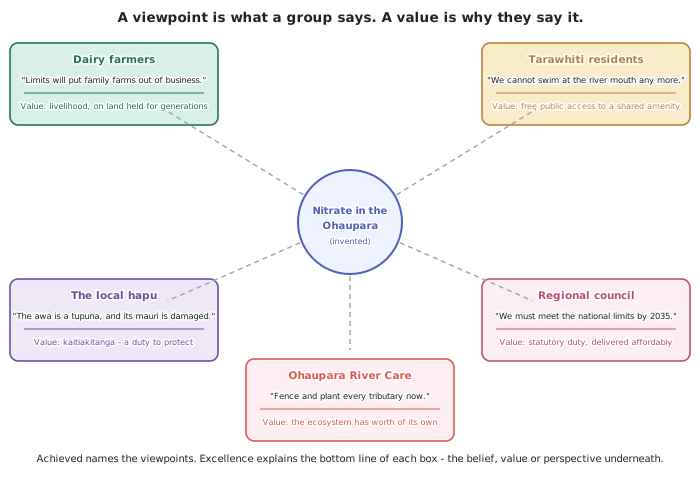
- A viewpoint is what a group says they want. We want the nitrogen cap dropped.
- A value is why they want it. Because a family farm held for three generations should not be made unviable by a rule.
- The standard's grades follow that split exactly. Achieved names viewpoints; Merit adds specific information to them; Excellence explains them by incorporating beliefs, values and/or perspectives — the bottom line of each box in the diagram above.
- Two groups can hold the same viewpoint for opposite reasons, and noticing that is worth more than adding a sixth group. A farmer and a council officer may both oppose an immediate cap — one because it threatens a livelihood, the other because it would not survive a legal challenge.
The groups to cover, and how many
- Cover every group with a real stake, and do not pad the list. Four to six well-explained groups is a strong submission; nine listed ones is a weak one.
- In the invented Ōhaupara case:
- Dairy farmers — the limits will put family farms out of business. Value: livelihood, and land held across generations.
- Tarawhiti residents — we cannot swim at the river mouth any more. Value: free public access to a shared amenity.
- The local hapū — the awa is a tūpuna and its mauri is damaged. Value: kaitiakitanga, an obligation to protect rather than a right to use.
- The regional council — we must meet the national limits by 2035. Value: statutory duty, delivered at a cost ratepayers will accept.
- Ōhaupara River Care — fence and plant every tributary now. Value: the ecosystem has worth of its own, independent of what people get from it.
- A group is not the same as a person. One farmer's opinion is not the farmers' viewpoint, and a submission built on one interview per group is thin. Use the group's stated position — submissions, public statements, a survey of several members — and say how you know it.
Perspectives, and why they are not the same as opinions
- A perspective is a way of seeing the world that a group brings to every issue, not just this one. An economic perspective asks what something costs and who pays. An ecological perspective asks what the system can absorb. A cultural perspective asks what the place means and to whom.
- The same fact reads differently through each. The 53 ha of seagrass lost since 2005 is a loss of habitat to an ecologist, a loss of a food-gathering place to the hapū, and — to a farmer facing a cap — a figure that has not yet been shown to be caused by nitrate rather than sediment.
- Naming the perspective explains the disagreement without accusing anybody of being wrong, which is precisely what "fully explain, showing insight" is asking for.
- Do not caricature. A submission where the farmers are greedy and the environmentalists are noble has stopped explaining and started campaigning, and markers read a lot of them.
Turning a listed viewpoint into an explained one
- The three-part sentence that always works: [Group] holds that [position], because [value or belief], and the evidence they point to is [specific fact].
- Worked through: The regional council supports a staged nitrogen cap, because its statutory duty is to meet the national bottom line by 2035 and it has calculated that fencing alone would leave the catchment above it, pointing to its own modelling that riparian planting cuts sediment by about 40 per cent but nitrate by under 10 per cent.
- That single sentence carries all three grades: the position (Achieved), the specific evidence (Merit), the value (Excellence).
- Write one of those per group and part 2 is finished. Five sentences, each with all three components, beats three pages of description.
Where the marks are lost
- Listing instead of explaining. The farmers disagree with the council is a fact about the issue, not an explanation of a viewpoint.
- Giving each group one line and the group you agree with five. Markers can see it, and it undermines part 5, where you have to argue against the alternatives fairly.
- Leaving out the group with the least sympathetic position. The submission needs them most: they are usually where the strongest counter-argument lives.
- Confusing a viewpoint with a course of action. Fence the waterways is an option. Farmers should not bear the whole cost of fixing a problem the whole district benefited from is a viewpoint.
Worked Example
Worked example
A student writes this for part 2:
Upgrade it to Excellence for one group, using the three-part sentence.
Answer:
Step 1 — pick the group whose position needs most explaining. The farmers, because theirs is the position a reader is most likely to dismiss without understanding it.
Step 2 — find the position, precisely. Not they do not want the cap, but what they actually argue: they accept fencing and planting, and they oppose a nitrogen cap set per hectare rather than per farm.
Step 3 — find the specific evidence they point to. The invented compliance figures: 89 of the 118 farms have already fenced their main waterways, at an average cost of about $41,000 each; and the modelled income effect of the proposed cap is about $310 per hectare per year, which on a 180 ha farm is about $56,000 a year.
Step 4 — find the value underneath. Two, and they are different: livelihood on land held across generations, and fairness — a conviction that a cost created over twenty years by a district-wide conversion should not fall on the current owners alone.
Step 5 — assemble the sentence, then add the perspective.