The paper, the clock and the paragraph
What the paper gives you
- Three questions, and all three are compulsory. The booklet says you should attempt ALL the questions — there is no choice and no optional section.
- One question per text, and the three texts are one prose extract, one poem and one non-fiction text. Each question is labelled with its type.
- The order of the types changes from year to year. Do not walk in assuming Question One is prose.
- The texts are printed in a separate resource booklet pulled from the centre of the answer booklet, and each question gets roughly two booklet pages of writing space.
What is NOT in this paper
- Two things belong to the Level 3 version, AS91474, and students who have seen L3 material import them by mistake.
- There is no minimum number of aspects. L3 requires at least two per question and says so in the stem. Level 2 does not count.
- There is no comparison question. At L3 the third question compares two texts. Here the third is another single-text analysis.
- So you decide how many aspects to cover, which makes you responsible for going deep rather than wide.
Breaking the stem
- Read the stem first, then the text. Reading cold means you notice whatever is loudest.
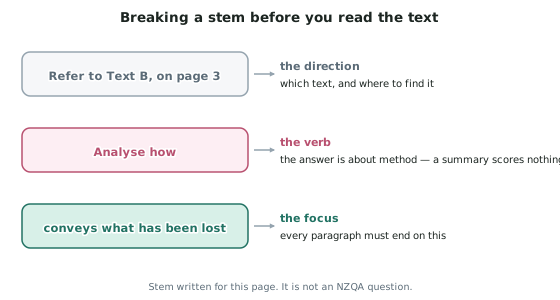
- The focus is a constraint, not a suggestion. Excellent analysis of something the question did not ask about scores badly.
- Read the focus word by word. Lost, not changed, implies value — so the text must establish the thing mattered before it went.
Reading in passes
- Give each pass one job. Doing all four at once is why unfamiliar texts feel impossible.
- Pass one — no pen. Read for sense, then note your reaction in three or four words: uneasy, sad but not sentimental, being told off. Your reaction is evidence about the text's effect, and this is the only time you will read it without knowing what happens.
- Pass two — words. Connotations, unusual choices, small qualifiers.
- Pass three — syntax and structure. Sentence lengths, where they change, where paragraphs or stanzas break, first and last sentences.
- Pass four — voice and what is withheld. Who narrates, what they know, what tense, what they never say.
- Then decide your reading in one sentence before you write: this text does X by doing Y. Every paragraph then has something to be part of, and you can see which observations do not belong.
The clock
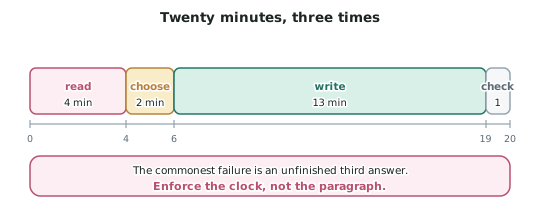
- Check the current NZQA assessment specification for your year for the exact time allowed. The three-question structure has been stable, but times are set annually.
- If you have overrun, do not cut the reading time on the last text — cut a paragraph instead.
The paragraph shape
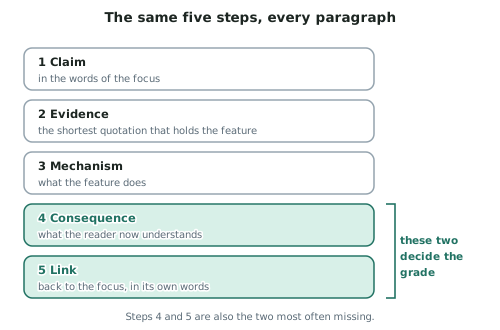
- Open with the claim, not the quotation. A paragraph beginning with copied text makes the marker wait to find out why they are reading it.
- Every paragraph must end on the focus. If it could be moved unchanged into an answer about a different focus, it is not yet answering this question.
- Some of the best evidence has no quotation marks available. It still counts if you point at it precisely — the father is given no dialogue; this is the last sentence of the poem.
- Behind schedule? Cut the third paragraph, not the depth of the first two. Cut examples inside a paragraph, keeping the mechanism and the consequence. Never cut step 5. Out of time entirely, write remaining points as complete sentences — a marker can credit a stated interpretation, but not a plan.
Worked Example
Worked Example
A stem in the paper's own shape, written for this page.
Step 1 — break the stem. Analyse how means the answer is about method, so a summary scores nothing. What has been lost: lost implies value, so the poem must establish the thing mattered before it went; has been means the loss is complete, so the poem speaks from after.
Step 2 — predict in one line. Probably: the poem establishes the value indirectly, then shows the world without it. Now your first read has a shape.
Step 3 — test the candidates with the removal test.
| Candidate aspect | If removed | Use it? |
|---|---|---|
| Planted over decades, felled in four days | The loss stops being disproportionate | Yes |
| Nothing you notice is doing its job | The poem never explains the family's inattention | Yes |
| The final couplet, brightness against wind | The poem has no ending and no loss | Yes |
| The word rows in line one | Almost nothing changes | No |
Step 4 — order them so the poem's own logic appears. Value established, then speed of removal, then consequence. Three paragraphs, thirteen minutes, one point each.