Framing the inquiry
Why framing decides the grade
- Framing the inquiry in an authentic context is the first of the three components the Explanatory Notes name, and the only one you finish before doing any work.
- A badly framed question cannot be rescued by good research. If the answer was obvious before you started, the best possible report restates what was known — and a report that restates has concluded nothing.
- Framing fixes three things you cannot change later: what evidence exists, whether there are two sides to weigh, and whether you can generate information rather than collect it.
The grade ladder, once
- Achieved — a developed conclusion: reasoned from the information you gathered, not asserted at the end of it.
- Merit — convincingly, glossed by the EN as reasoned, clear and informed: every claim traces to a named piece of evidence; the reader always knows what is claimed and on what basis; and the report shows command of the material including the parts that cut against you.
- Excellence — perceptively, glossed as insightful and/or original. The or is real: you need one route, not both.
- No grade step is reached by adding length or sources. These words are used on every page here and always mean this.
What authentic means, and what makes a question usable
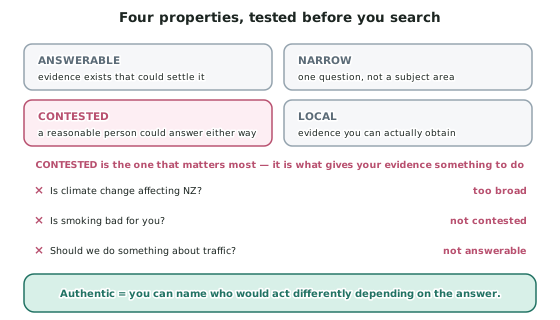
- Authentic context means someone could actually need the answer — a decision, a choice or a problem is attached to it.
- Should our council make the Main Street bus lane permanent? — the council, at a meeting with a date on it.
- Is social media bad for teenagers? — nobody. No decision, so no inquiry.
- Authentic does not mean personal, and it does not mean important. A small live question beats a large settled one every time.
- Answerable — if you cannot name a likely source in thirty seconds, it is not answerable at this scale. Narrow — Transport in our town is a subject; Should the 8.10am bus run through the holidays? is a question. Local — evidence you can genuinely obtain, and people who will answer an email.
Sub-questions, and recording the framing
- Break the question into three or four sub-questions, each answerable by one source. They become the skeleton of your notes and report.
- A sub-question nothing answers is information — either the search failed, or nobody has measured it, and the second is often the most interesting finding in the inquiry.
- Expect to reword the question once after the first search, and record the rewording and the reason. That record is direct evidence of a systematic process.
- Do not write your expected answer down as a prediction to defend, or you will produce a report that only collects.
Worked Example
Worked Example
Three proposed inquiry questions. A student must choose one.
- A: Is fast fashion bad for the environment?
- B: Should our town centre introduce paid parking?
- C: Should our school move the start of the day from 8.45am to 9.15am?
Test each against the four properties and frame the winner.
Step 1 — test all three. A fails, on the property that matters most: it is not contested, so a report could only assemble agreement, and its evidence is global and secondary. B and C pass all four.
Step 2 — choose between B and C. The deciding question is what evidence can I actually get. On B the student is one voice among many; C has a board, a principal and about 900 people affected, all reachable. C is chosen, because it is where the student can generate primary information.
Step 3 — the authentic context, in one sentence.
Step 4 — the sub-questions. What does the evidence say about later starts and adolescent sleep? Who here would be affected badly, and how many are there? What are the fixed constraints — buses, shared staff, sports draws? What happened at schools that already moved?
Step 5 — the rewording. The first search turned up something unexpected: the constraint is not the start time, it is the bus contract, and the buses run on a network timetable the school does not control.
It is narrower — one option, one constraint — and more contested, because the easy version of the argument has gone. The record of the change is evidence of a systematic process.