Locating, processing and evaluating information
Strategies, not sources
- The EN names selecting strategies for locating and processing information — one component with two halves, and both are marked.
- Strategies is the assessed word, not sources. Two students can end with the same five sources; the one who shows a deliberate, varied, recorded search has met more of the standard.
- Processing is what you do with material between finding it and concluding. Failing reports are rarely short of sources — they are short of processing, so the sources sit unaltered and the conclusion is bolted on.
Search technique that changes what you find
- Use the words your sources would use, not the words you would. A council writes parking occupancy, not how busy the carpark is; a transport agency writes mode share. Read one official document, take its terms, then search again.
- Restrict the search to a domain with the site: operator — site:govt.nz, site:stats.govt.nz, or your council's domain.
- Search for the document type, not the topic. Adding submission, agenda, long-term plan, officer's report or dataset returns primary material, not commentary.
- Search for the disagreement deliberately, and follow citations backwards to the original.
New Zealand sources almost no student uses
- Your council's own website — the Long-Term Plan, the Annual Plan, agendas and minutes, and public submissions.
- Submissions are the most under-used source in the country for this standard. They give both sides of a local argument, in their own words, at full strength.
- Stats NZ — census and survey data, down to suburb level. RBNZ and MBIE for economic, industry and regional data. Health New Zealand | Te Whatu Ora for health and service data.
- Parliamentary Library research papers — short, balanced briefings written for MPs — and Te Ara — the Encyclopedia of New Zealand for historical and cultural background.
- Your public library's online databases — free with a card, holding archive and journal material not on the open web. News sites are good for what happened and when, but treat an article as a pointer to a source, not the source.
Generating information that does not exist yet
- The strongest move in this standard is to ask a real person one specific question. Not can you send me any information about the pool? but how many weekday morning swimmers are in booked programmes rather than casual entry?
- Direct observation counts. Counting cars at 8am on four days is primary data nobody has published.
- A voluntary survey shows what respondents think, not what the group thinks. Say so if you run one, and record primary information exactly — date, source, the words used.
Processing: the grid
- Write notes in your own words, separating what the source says, what you infer, and what it does not settle. Record every number with its base: 34 per cent is unusable a week later; 34 per cent of 212 submissions is evidence.
- Group by sub-question, never by source. Rows are sub-questions, columns are sources, cells hold the evidence written out, never a tick.
- Read across, not down. Reading down tells you what one source says, which you knew. Reading across shows four sources on the same question — where the thinking happens.
- Three patterns matter. Agreement — note it, but check it is not circular: three pages citing one original is one source. A conflict between two reliable sources — the most valuable pattern in the inquiry, so do not pick a side, ask how both can be true. An empty row — the search failed, or nobody has measured it, and only the first is a mistake.
- Name the load-bearing evidence — the item that, if wrong, would change your answer.
- Record as you go: every source with its date and origin, every search term and what it returned (the evidence of strategies), and every rejection with its reason. A rejected-sources list shows judgement; a kept list shows only accumulation.
Two judgements, not one
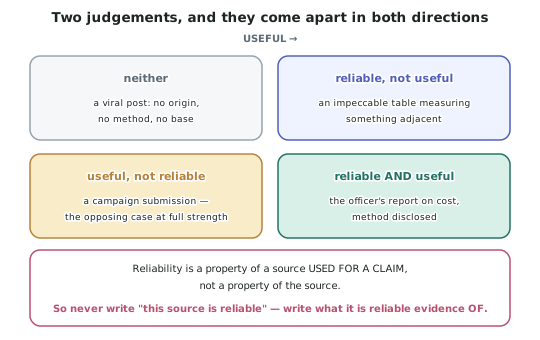
- The EN names evaluating the reliability and usefulness of information, so judging only reliability leaves half of it undone. Reliability asks: is this true? Usefulness asks: does this do work in my inquiry?
- Usefulness is relative to your question, so a source discarded in week one can matter in week three.
Five questions to ask of every source
- Who made it? Look for the basis, not the byline.
- Why does it exist? To inform, to sell, to campaign, or to comply with a legal duty? Purpose predicts bias far better than tone does — a calm page can be advocacy, an angry submission meticulous.
- When was it made? Ask what has changed since, not how old it is.
- What is it based on? A source that shows its working — data, method, base numbers — can be checked.
- Who disagrees? If nobody appears to, either the matter is settled or your searching is inside one side's framing, and you cannot tell which without looking.
- Four things go wrong most often. A statistic with no traceable source; circular sourcing; a correlation described with a causal verb; and above all a real number used misleadingly — number true, impression false. That means a percentage with no base, a change with no time period, or an average concealing a distribution, the commonest fault in council material.
Bias is not unreliability
- A biased source is one written to advance a position. That is a fact about its purpose, not its accuracy.
- Students discard biased sources on principle, and it is the most costly habit in this standard. A business association's submission opposing a proposal is reliable evidence of what that side argues and of what it thinks its strongest ground is. It is often first-hand about operational detail nobody has published. It is not evidence that its claims are correct, nor of how many people hold the view.
- Its account of the other side is the one part to leave alone. Every advocate states the opponent's case in its weakest form.
- Neutrality is not authority. A council report is highly reliable about its figures and an argument, and a set of sources that all sound neutral is a warning about your search.
- State every limit as a fact about the method rather than as a hedge — the sample was self-selecting, not this may not be completely accurate.
Worked Example
Worked Example
A source set written for this page. A council proposes charging for parking at the main surf beach.
- A — the officer's report: cost, projected revenue, and occupancy averages 41 per cent across the year.
- B — a surf lifesaving club submission opposing the charge: the carpark fills before 9am on patrol days, and members would pay to volunteer.
- C — a widely shared social media post: 90 per cent of locals oppose the charge.
- D — a tourism operators' association submission supporting the charge: free parking is taken by all-day users.
- E — the student's own count: cars at 9am and 1pm on four days, two summer and two winter.
Judge each for reliability and for usefulness.
| Reliable evidence of | Useful? | |
|---|---|---|
| A | The cost and revenue figures | High — the only cost evidence, method disclosed |
| B | What the club argues, and the volunteering cost | High — a harm no other source raises |
| C | Nothing — no origin, method or base | None |
| D | The strongest case for charging | High — names a testable claim |
| E | The four days counted | High — the only evidence of the pattern |
Chase the number. Source A's 41 per cent is the pivot of the council's case. The appendix gives the method: an automated count averaged over all daylight hours, every day of the year — including every winter Tuesday. The figure is accurate and answers a question nobody is asking.
The conflict, and how both can be true. A says 41 per cent; B says the carpark fills before 9am; E found both summer 9am counts at capacity and both winter 1pm counts under a fifth full. All three are accurate: the average is low because use is concentrated. That reframes the inquiry as what to do with a facility at capacity for a few hours and near-empty otherwise — an argument for time-limited charging.
Two rejections, on different grounds. A Stats NZ table of vehicle ownership by district is impeccable and answers nothing here, so it is rejected for usefulness; the viral post is rejected for reliability.
Using the biased source properly. Source D claims all-day users dominate and gives no evidence. Discarding it loses the strongest case for the proposal; repeating it treats an argument as a finding. Test it instead. The student notes which cars are present at both counts: 19 of 60 — a third, not a majority.