The conclusion, the write-up, and the grades
What the standard means by a conclusion
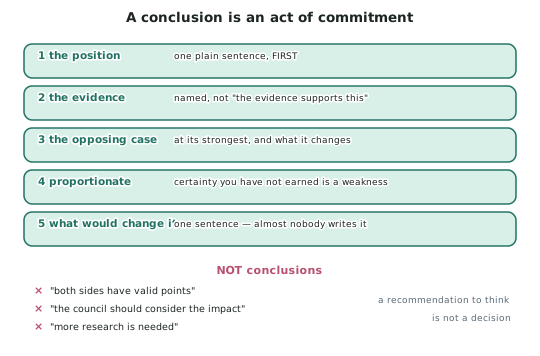
- The Explanatory Notes define a conclusion by what it may do: expressing an opinion or judgement, reaching a decision, or suggesting a solution. All three are acts of commitment. There is no fourth option in which you describe what you found and stop.
- Achieved requires the conclusion to be developed — reasoned from the information you presented, not asserted at the end of it.
- Most reports that fail do so with the same sentence: there are arguments on both sides and it is a complex issue. The complexity is the reason a conclusion is worth something, not a reason not to reach one.
Committing without overclaiming
- These all commit, so all are conclusions: a decision (the council should not close the pool on weekday mornings); a qualified decision (the charge should be introduced, but limited to 9am–1pm in summer); a conditional decision (proceed only if a supervised early room is provided); a solution (consolidate both programmes into one three-hour window); a judgement (the council's case is sound on cost and has not established the effect on users).
- These are not conclusions: both sides have valid points; the council should consider the impact on users, a recommendation to think; and more research is needed, unless you also say what you conclude on the evidence you have.
- A qualified conclusion is still a conclusion. Qualification states the limits of your evidence; hedging refuses to say anything.
- To get from the grid to the position, start from the row that decides it and write the resolution of your central conflict as a claim in your own words. Then test that position against the strongest opposing source before you write it up.
The process is part of what is marked
- The three EN components are all things you did, and a marker can only credit what appears on the page, so a brilliantly researched inquiry written up as a bare argument loses marks for work that was done.
- A write-up cannot invent a process either. Reconstructed search records read as reconstructed — too tidy, no rejections, no dead ends.
A structure that shows all three components
- The question and why it matters — the question, the authentic context in a sentence, who is deciding. If you reworded, say so here, with the finding that caused it.
- How you searched — the strategies, not a list of sources, including the rejected sources and the reason for each.
- What you found, organised by sub-question — never by source. The disagreement and how it resolves gets the most space, because that is where the thinking is.
- The conclusion, then the source list with a line on each: what it is, who made it, what it gave you.
- Evaluate in-line, in the sentence that uses the source, in two clauses: what it shows, and what it does not. A table at the front is not enough, because a reader cannot carry twelve judgements forward onto individual claims.
- Attribute arguments, assert findings. The association argues that all-day users dominate; my count found 19 of 60 cars present at both times. The verb tells the reader the status of the claim.
- Two faults cost most marks: an evaluation section that never returns, and a conclusion introducing new evidence.
Merit and Excellence
- Reasoned — every claim traces to a named piece of evidence, with the steps written out and the load-bearing evidence named.
- Clear — clarity here is structural: one claim per paragraph, stated first; numbers with their bases; every statement's status marked by its verb.
- Informed — command of the material, including the strongest opposing case at its strongest, the limits of your own evidence, and what is not known. A one-sentence opposing case fails informed on its own.
- Insightful means seeing something a competent reader of the same material would not; original means producing something that was not in the material at all. You need one route, not both.
- The obstacle is specific to this standard. Information literacy is taught as a collection discipline, and perfect collection only produces an accurate account of what has been written. Insight is not in the sources; it is in what the sources do to each other — which is why able students plateau at Merit.
- Four routes that work: resolve a conflict between two reliable sources by asking how can both be true; notice what nobody measured, since if every document quantifies cost and describes effects in adjectives, that asymmetry shows how the decision is framed; generate primary information aimed at the empty row; or be changed by the opposing case at full strength.
- Four substitutes markers recognise: more sources; a bigger topic; stronger language; more elaborate source evaluation. None is insight, and a real insight must change the recommendation.
Worked Example
Worked Example
An inquiry written for this page. A town's only public pool: the council proposes closing it on weekday mornings in winter to save money.
The processed findings:
- The officer's report claims a saving of about $34,000 a year and shows low average morning attendance.
- The pool manager, emailed one question, confirms most morning users are in two booked programmes — learn-to-swim classes, and an aquajogging group referred by a physiotherapy service.
- The nearest alternative pool is a 40-minute drive, and a business association submission supports the closure because the pool runs at a deficit.
- The student's count over five mornings: 31 to 44 people, of whom 26 to 38 were in the two programmes.
Three attempts at a conclusion, graded.
There are strong arguments on both sides. It is a complex issue. Fails — nothing is concluded. The council should not close the pool. Everyone deserves access to swimming. Fails as developed — it commits, but on a general principle, not the evidence. Do not close weekday mornings; consolidate both programmes into a shorter window. Works — it commits, and could only have come from the findings.
The conclusion as written.
Check it against the five parts. Position in sentence one; evidence named; the deficit argument granted, which is what produces the consolidation; a proportionate claim that accepts the saving figure; and a last paragraph saying what would reverse it.