Convincing, effective, and a distinctive personal voice
Merit: what "convincingly" adds
- Merit is convincingly crafted and controlled writing. The Explanatory Notes gloss convincingly as reasoned, clear and discerning.
- Achieved asks whether the choices were deliberate. Merit asks whether they were the right ones, and whether they held. Nothing new is added — the same four features, judged more strictly.
- Discerning means the choice is right for this piece. A striking metaphor in a deliberately flat piece is a good image and a poor choice.
- Self-check: for each effect, ask why here and not two sentences earlier? If there is no answer, the choice was available rather than selected.
- Sustained means the whole piece. A brilliant opening followed by four ordinary pages is an Achieved piece with a good first paragraph. The drop-off is predictable — openings get rewritten most, endings second, the middle least — so start a revision pass somewhere other than the start. Register, tense, person and distance must hold across the piece and across both submissions.
- Coherence is built at the join between paragraphs: prefer real connectives (so, but, even so) to additive ones (also, furthermore).
- Over-writing is the commonest Merit blocker — an image in every paragraph and no plain sentences, so nothing is emphasised. Its opposite, under-writing, is diagnosed by the same question: does the sentence contain a choice? The repairs are opposite — cut the over-written piece; build the under-written one out from its one real detail.
Excellence: three separate requirements
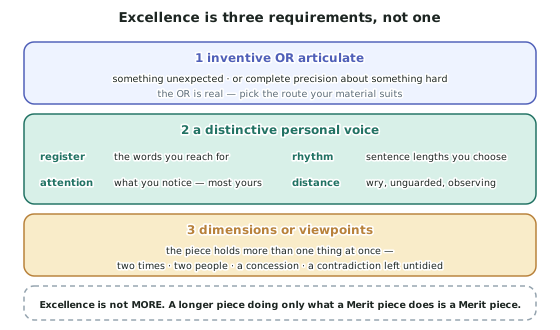
- Inventive OR articulate — two legitimate routes. The or matters.
- Inventive — the language does something unexpected: an unusual structure, a form used against type, an angle that changes what the piece is about. Uncontrolled invention reads as accident.
- Articulate — no invention at all, and complete precision about something genuinely hard to say. The risk is being precise about something ordinary.
- Choose the route that suits your material. A student who is not naturally inventive writes a better articulate piece than a forced inventive one.
Voice: four things it is actually made of
- Voice is not a mood or a personality, and write like yourself cannot be acted on. Voice is the sum of a writer's repeated choices, and each of the four is a technical decision.
- Register — which words you reach for by default. The consistency creates the voice; the deliberate break gives it force.
- Rhythm — short declaratives, long accumulating sentences, or a chosen alternation. The most audible component and the least often worked on.
- Attention — what you notice. Two people describing the same kitchen produce different pieces because one attends to the light and the other to what hands are doing. The component most specific to you.
- Distance — close and wry, close and unguarded, or cool and observing.
- Distinctive means these choices are consistent enough that the piece could not have been written by anyone else in your class. It does not mean unusual.
- What does not build a voice: bigger words, inserted jokes, imitation, or writing more informally. What does: material only you have, and cutting every stated feeling to see which details survive — that is where your attention went, and it is your voice showing.
Dimensions or viewpoints
- This is the part students most often miss. It means the piece holds more than one thing at once. A single-note piece — this was sad, and here are six sad details — has one dimension however well written it is.
- Ways to get a second dimension:
- Two times — the narrator then and now, and the gap between what was understood then and what is understood in the writing.
- Two people — someone else's account of the same event, allowed to stand. In argument writing this is the counter-position, taken seriously rather than knocked down.
- A concession — in reflective writing, and I was also relieved. Students delete this sentence because it feels disloyal, and it is nearly always the best one in the piece.
- An unresolved contradiction — two true things that do not fit, left untidied.
- Do not manufacture it. A viewpoint bolted on in the last paragraph reads as bolted on.
Worked Example
Worked Example
One paragraph of material, written for this page: a student waits with her father while their dog is put down at the vet. Only the handling changes.
Version 1 — no voice.
Every sentence is available to anyone: no attention, no rhythm, generic register — and single-dimension, sad and sad again.
Version 2 — attention added, and nothing else.
The writer has started noticing, including a fact about her father only she could supply. He does not read posters is four words of characterisation, understatement and grief at once. The feeling is nowhere stated and fully present.
Version 3 — rhythm chosen. Add an accumulating clause before the short sentences — …and a rack of pamphlets on dental care for cats — so the accumulation performs the waiting, and distance is set as observing rather than confessing.
Version 4 — a second dimension. Then add:
Why this is the largest step. The piece now holds three things at once — grief, embarrassment and a small self-interested thought — unresolved, across two times and two versions of the same event. The good rug back in the hall is the sentence most students would delete, and it is the best sentence in the piece.
Tracing the grades. Version 1 is below Achieved; version 2 reaches Achieved to Merit on attention alone; version 3 is Merit; version 4 is Excellence, and the difference is the dimensions. No word became longer anywhere in the sequence and version 4 contains no metaphor — this is the articulate route.