Choosing your pieces, drafting and cutting
Crafted and controlled are two different things
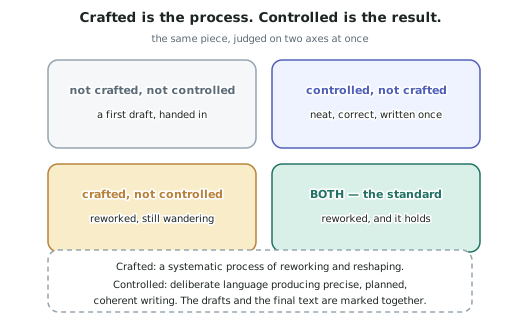
- Three demands hide in the definition of crafted.
- Systematic — the reworking is planned, not a proofread. You know what each draft is for before you open it.
- Reshaping — structure changes, not just words. Cutting an opening paragraph is reshaping; fixing a comma is not.
- A planned whole — the piece has an intended effect, and every choice serves it.
- Deliberate is the load-bearing word in controlled. The same unusual choice reads as craft in a controlled piece and as a mistake in a careless one, because a marker credits only an effect they can tell was intended.
- Crafting is visible in the drafts, not only in the final piece. A final version that differs from draft one by a few corrections has not been crafted, whatever its quality.
Choosing your two pieces
- You need at least two pieces, and they should be different — different purpose, form or voice. Two similar pieces demonstrate one skill twice.
- Both pieces count. The grade is a judgement about the selection, so a strong piece paired with a weak one pulls the whole submission down.
- What each common form is good at:
- Personal or reflective — the strongest route to distinctive personal voice, which Excellence names.
- Creative or short fiction — good for imagery and syntax; risky if you attempt a whole plot in a thousand words.
- Formal or argument — good for structure and precision; harder to sound like anyone in particular.
- Description — good for vocabulary and concrete detail; needs a shape or it becomes a list.
- A useful pairing is one piece where the voice does the work and one where the structure does.
Choose a small subject
- The single biggest predictor of a good piece is narrow scope. An afternoon beats a summer; one conversation beats a friendship. Small subjects force detail, and detail is where craft is visible — a large subject can only be covered in generalisations, which give deliberate language choices nothing to work on.
- Local and ordinary beats big and dramatic. A Whangārei bus stop you have stood at is better material than an imagined war, because a dramatic subject arrives with feeling already attached and a flat account of it still moves a reader — which flatters writing the marker is meant to be assessing.
- The test: can you list three concrete details of this subject right now, before drafting? If not, it is too large.
Decide the effect before you draft
- Write one sentence: what should a reader feel or understand at the end? Every later decision is judged against it, and it must be specific enough to rule things out — the reader should feel sad rules nothing out.
- Fix the voice and the distance — close and unguarded, close and wry, or cool and observing. This decides whether the piece states its feelings or leaves them to the details.
- Fix the tense and the person, and keep them. Both work; drifting does not.
- Plan the shape, not the content. Know where it starts — usually at the first moment something changes — and know the last image.
Give each draft one job
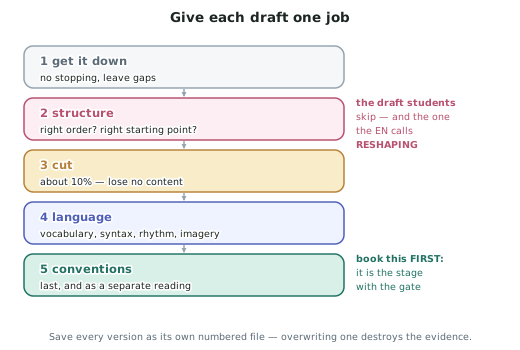
- Doing everything at once is why revision feels impossible. Each stage is easy alone.
- Save each version as a separate numbered file, with one line at the top saying what that draft is for. Overwriting one file destroys the evidence that the piece was reworked.
Why cutting beats adding
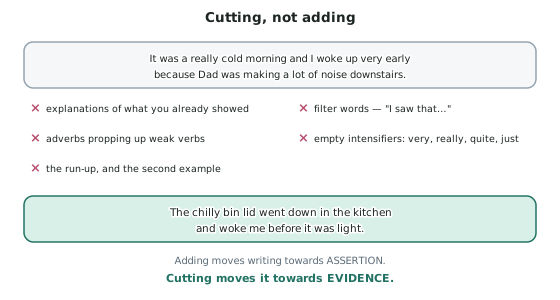
- Weak writing is usually diluted, not missing something. Cutting removes what was competing with the good sentence already there, and it forces precision: once walked quickly cannot be propped up by its adverb, you must choose between hurried, strode and ran.
- An adjective is a claim the reader must take on trust. A really beautiful old wooden house asks for four; the house leaned gives them something and lets them conclude the rest.
- Cut abstract nouns where something concrete exists — the situation was difficult names nothing a reader can picture.
- What cutting cannot fix: a subject that is too large, a missing idea, or a structural fault. Over-cutting is a real failure too — the short reflective sentence between two events is load-bearing and looks disposable.
- Read the finished piece aloud, slowly, standing up. It catches sentences you run out of breath in, repeated words the eye skips, and missing or doubled words. Better still, have someone read it to you — every place they stumble is a place your punctuation misdirects a reader.
Worked Example
Worked Example
A plausible first draft opening, written for this page.
Task: take this through the drafting sequence, one job per draft.
State the effect first. The reader should feel a year's distance closing in one ordinary sentence.
Draft two — structure. The paragraph opens with weather and works towards the event. The first moment something changes is the noise; the first moment something means anything is the chilly bin. Everything before that is a run-up. Start at the sound.
Draft three — cut. Really cold, very early, quickly — intensifiers and a propped verb. I saw that — a filter word. Which meant we were going fishing — the chilly bin says it. And the important one: I felt quite excited explains a feeling the details already produce.
Draft four — language. Precise verbs, deliberate variation in sentence length, one concrete detail doing the emotional work.
Notice what the reworking was not. No word was made longer — the final version uses plainer vocabulary. What changed was where the piece starts, what was removed, and which detail carries the feeling.