Vocabulary, syntax and stylistic features
Vocabulary: precision, not impressiveness
- The EN names exactly four language features — vocabulary selection, syntax, stylistic features and written text conventions — and the first three are on this page. They are assessed as choices, not quantities.
- The exactly right word beats the impressive one. Precise is the EN's own test.
- Choose the concrete over the abstract. Abstract nouns name categories; concrete nouns name things a reader can see.
- There was a lot of vegetation → gorse to the fence line.
- He showed his emotion → he put the cup down without drinking from it.
- Name things exactly. A kōwhai is not a tree; a Fonterra tanker is not a truck. Exact names cost no extra words.
- The near-miss word is an accuracy failure. Refute does not mean deny. A near-miss is worse than a plain word, because it tells a marker the vocabulary is beyond your control.
- Connotation is part of the meaning. Thin, slender, skinny and gaunt take four different attitudes to the same body.
- Verbs carry more than adjectives. The gate was old and rusty → the gate dragged.
- Register — the level of formality — is set by vocabulary, and consistency is the requirement. A formal argument that suddenly says pretty gutted has broken its own contract, and the marker cannot tell whether that was a choice or a slip.
Syntax: what sentence construction controls
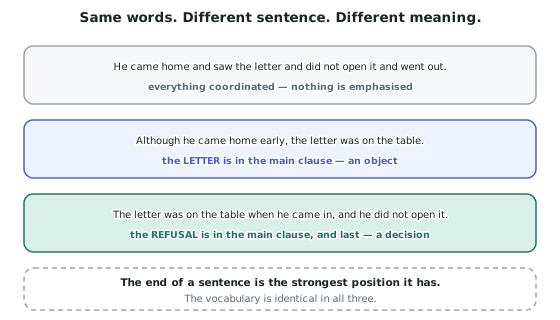
- Length controls pace. Short sentences are quick and final; long ones accumulate and delay. Variation is where the craft is, and a short sentence after a long one is the most reliable effect in English.
- Subordination controls emphasis. The main clause is what a reader remembers.
- Fragments are legitimate and dangerous. A deliberate fragment is emphatic; an accidental one is a grammar error, and only an otherwise clean piece makes the difference visible.
- Passive voice is a tool, not a fault. Use the active by default; choose the passive when the doer is unknown, irrelevant or being concealed — the service was withdrawn is exactly right when nobody will say who withdrew it.
- The strongest syntactic choices do what they describe. A sentence about a long wait can be made to wait for its main verb — once or twice in a piece, or it is a gimmick.
Stylistic features: imagery, tone, rhythm
- Stylistic features covers imagery, rhythm, repetition, tone and voice. The governing question is always the same: does this do work the plain version could not? If not, it is decoration costing you space.
- A comparison must add something the literal cannot. The sea was like a blue blanket replaces something the reader can already picture with something less interesting.
- Draw images from the world of the piece. A farm piece should reach for farm comparisons — the most reliable way to make imagery feel intentional, because the image belongs to the same reality as the events.
- One strong image beats three adequate ones. Images compete: two in a paragraph halve each other. Extend one rather than adding another, and watch for dead metaphors — a sea of faces — which are not wrong, just invisible.
- Tone and distance must be chosen and held, because a deliberate shift only reads as one when everything before it was consistent.
- Repetition of phrasing is a technique; repetition of ideas is a fault. Opening three paragraphs the same way and breaking the pattern in the fourth is a shape the reader can feel.
- A motif is the most efficient stylistic feature available. Introduce a concrete detail plainly, return to it in the middle, and return to it at the end changed. It costs almost no words after the first appearance and supplies an ending prepared since paragraph one. Do not explain it.
Worked Example
Worked Example
One event, written for this page. The information is identical in every version; only the syntax changes.
Version 1 — flat, everything coordinated.
Every clause has equal weight, so the reader has no instruction about what matters. This is the default shape of a first draft.
Version 2 — the letter in the main clause.
The letter is now the subject of the main clause, so it is what the reader carries forward.
Version 3 — the refusal in the main clause, and at the end.
The refusal sits in the strongest position available. Same information; the reader now notices a decision rather than an object.
Version 4 — delay, using a long sentence that withholds its verb.
The sentence makes the reader wait, and waiting is the content. Note what the subordinate clauses smuggle in: two people, an argument and four days, none stated.
Version 5 — short sentences, and one word at the end.
Four short sentences produce the flatness of a routine. Then either arrives last and reveals that this has happened before.