Written text conventions: the gate at Achieved
Why conventions are a gate
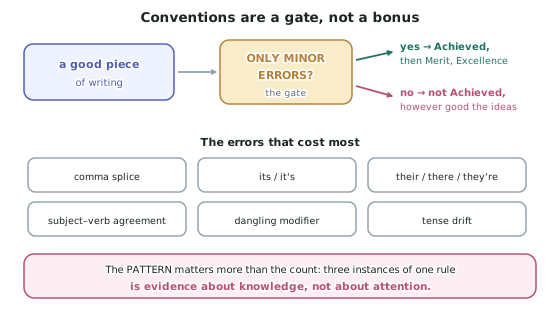
- Written text conventions — spelling, punctuation and grammar — are the fourth language feature the Explanatory Notes name, and the only one with a threshold attached.
- More students lose this standard to proofreading than to writing, and it is the only part that can be fixed with certainty, because the rules are finite and checkable. Publication standard means finished, not nearly finished.
- A minor error is a slip a reader passes over: a missing comma in a list, a typo. A serious error interrupts a reader, changes the meaning, or shows a rule is not understood.
- The pattern matters more than the count. Three instances of the same misunderstanding are one problem repeated, and that is worse than six unrelated typos, because it is evidence about knowledge rather than attention.
The errors that cost most
- Comma splice — two complete sentences joined by a comma. It was raining, we went anyway. Fix with a full stop, a semicolon or a conjunction.
- Apostrophes.
- Possession: the dog's lead (one dog), the dogs' leads (several). Plurals never take one.
- Contraction: it's means it is. Possessive its has no apostrophe — the commonest error in the subject.
- Homophones a spellchecker cannot see — their / there / they're, your / you're, whose / who's, practise / practice.
- Subject–verb agreement, especially with words in between: the row of houses was demolished — the subject is row, not houses.
- Dangling modifiers — Walking up the hill, the shed came into view. The shed is not walking. Fix by naming the actor.
- Tense drift — a past-tense narrative that slips into the present and back. Check by reading only the verbs.
- Missing words, and pronouns with no clear referent — she told her mother that her car had gone. Whose car?
Punctuation that does work
- Comma — separates items and marks off a subordinate clause. It cannot join two sentences on its own.
- Semicolon — joins two complete, closely related sentences: The bus stopped coming in March; nobody was told why.
- Colon — introduces a list or an explanation, and the part before it must be a complete sentence. Dash — an aside, used sparingly.
- Paragraphing is punctuation too, and paragraph length is a rhythm choice.
- Dialogue. The punctuation belonging to the speech goes inside the quotation marks, and a new speaker starts a new paragraph.
- "Get your jersey," he said. — comma inside, lower-case he, because it is one sentence.
- "Get your jersey." He picked up the rods. — full stop inside, capital He, a new sentence.
- "Are you coming?" she asked. — question mark inside, and no comma as well.
- This is the most visible convention error, because it repeats in every line of speech.
A proofreading method that works
- Do it as a separate pass, last, ideally on a different day. With a gap you read what is on the page instead of what you meant.
- Change how the text looks — print it, or change the font. The eye skips errors in a document it has seen fifty times.
- Read aloud, slowly, for missing and doubled words, then read backwards, sentence by sentence, for spelling — removing the meaning is what lets you see the letters.
- Search the document for the error you know you make.
- Never trust a spellchecker as a proofread. It cannot see their/there, its/it's, a missing word or a comma splice, and it flags correct words such as whānau, which trains you to click past its warnings.
- Breaking a rule on purpose is legitimate — a fragment, a one-word paragraph — but only in a piece that is otherwise controlled, because a marker can only credit an effect they can tell was intended.
Worked Example
Worked Example
The paragraph below was written for this page. It contains ten convention errors of the kinds that cost marks.
Task: find and fix every error, naming each.
| Error | Type | Fix |
|---|---|---|
| Its been | Contraction of it has | It's been |
| pool, we still walk | Comma splice | pool. We still walk |
| is still their | Homophone | there |
| Walking home in the rain, the building looks | Dangling modifier | …I think the building looks |
| My brother and me used to come | Pronoun case | My brother and I |
| saturday | Proper noun, no capital | Saturday |
| the queue of kids were | Subject–verb agreement | the queue of kids was |
| "Do you remember the diving board" he asked | Question mark missing inside the quotation marks | "…diving board?" he asked. |
| I dont | Missing apostrophe | don't |
| Their is a photo … thats all | Homophone repeated, missing apostrophe | There is … that's all |
Step 2 — group them, because the grouping is the diagnosis. The three apostrophe errors (Its, dont, thats) are one rule not applied three times — a single serious problem, fixable in two minutes by searching the document. The two their errors are one more, and a spellchecker finds neither.
Step 3 — judge it against the gate. Would a marker call these minor? No. The apostrophe errors repeat, the comma splice makes a reader stop, and the dialogue punctuation is wrong in the only line of speech. This piece does not reach Achieved, and nothing about the writing itself is the reason.