What unemployment is and how it is measured
The official definition
-
Stats NZ measures unemployment in the Household Labour Force Survey (HLFS), published quarterly.
-
To be counted as unemployed, a person must meet all three conditions:
- Without paid work in the survey week
- Available to start work
- Actively seeking work — they have taken specific steps to find a job
-
All three are required. Someone who wants a job but has not looked for one is not counted as unemployed.
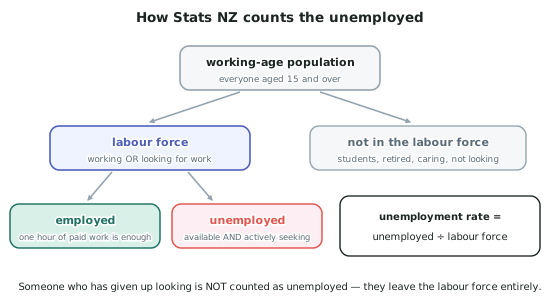
The groups you must be able to name
Working-age population
- Everyone aged 15 and over.
Labour force
- Those who are employed plus those who are unemployed — everyone working or actively looking for work.
Employed
- Anyone who worked for pay or profit in the survey week. One hour of paid work is enough to be counted as employed.
Not in the labour force
- Everyone in the working-age population who is neither employed nor actively seeking work: students, retired people, people caring for family full-time, people who are unwell, and people who have given up looking.
The unemployment rate
- The denominator is the labour force, not the population. Dividing by the total population is the most common calculation error in this standard.
Why the official rate understates the problem
Discouraged workers
- Someone who has looked for months, found nothing and stopped looking fails the "actively seeking" test.
- They leave the labour force entirely — so the unemployment rate falls, even though no one has found a job.
- This is why a falling unemployment rate is not automatically good news: check whether the labour force shrank.
Underemployment
- Someone working part-time who wants more hours is counted as employed, however few hours they work.
- The official rate counts them as fully employed.
Hidden unemployment
- People in training or study only because there is no work; people working far below their skill level.
Underutilisation — the broader measure
-
Underutilisation is a broader Stats NZ measure that adds together:
- the unemployed, plus
- the underemployed — part-time workers who want more hours and are available, plus
- the available potential jobseekers — available but not actively looking, plus
- the actively seeking but not available to start immediately
-
The underutilisation rate is always higher than the unemployment rate, often around twice as high.
-
Quoting both is exactly what the standard's "different definitions" clause is asking for.
Worked ExampleCalculating the rate, and reading it properly
An economy has these figures for one quarter.
| Thousands of people | |
|---|---|
| Working-age population | 4,000 |
| Employed | 2,600 |
| Unemployed | 110 |
In the following quarter, 30,000 unemployed people stop looking for work and no one else's status changes.
(a) Calculate the labour force and the unemployment rate. (b) Calculate the new unemployment rate after the 30,000 stop looking. (c) Explain whether the labour market has improved.
Step 1 — (a) The labour force
Step 2 — The unemployment rate
Note what is not in the denominator. The working-age population is 4,000 thousand, but 1,290 thousand of those people are not in the labour force — students, retired people, carers. Dividing by 4,000 would give 2.75%, which is wrong.
Step 3 — (b) After 30,000 stop looking
Those 30,000 people no longer satisfy the "actively seeking" condition, so they are no longer counted as unemployed. They leave the labour force altogether.
- New number unemployed: thousand
- New labour force: thousand
Step 4 — (c) Has the labour market improved?
No. The unemployment rate has fallen from 4.06% to 2.99% — a very large improvement on paper — and not one person has found a job.
- Employment is unchanged at 2,600 thousand. Exactly the same amount of work is being done.
- The rate fell only because both the numerator and the denominator shrank, as discouraged workers left the labour force.
- The labour force participation rate has fallen, which is the warning sign.
- On the broader underutilisation measure these people would still be counted, as available potential jobseekers — so underutilisation would be unchanged.