Unemployment on the PPF and the AS/AD model
Why three models, not one
- The standard names three models for this standard: the labour market, the PPF, and the AS/AD model.
- Each shows something the others cannot, and an Excellence answer integrates them.
| Model | What it shows about unemployment |
|---|---|
| Labour market | Why it happened — which curve moved and what happened to the wage |
| PPF | What it costs — output the economy could have produced and did not |
| AS/AD | How it fits the whole economy — the link to real GDP and the price level |
Unemployment on the PPF
- The PPF shows the maximum an economy could produce with all its resources fully employed.
- Unemployment means the economy is producing at a point INSIDE the frontier.
- The workers exist. The machinery exists. They are simply not being used.
- The gap between the point inside and the frontier is the output lost to unemployment — goods and services that could have been produced and were not.
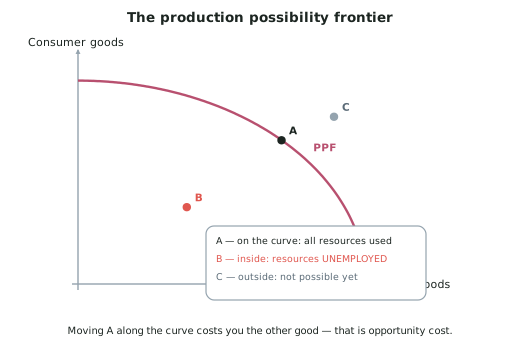
The two cases you must keep separate:
| Situation | On the PPF | Reversible? |
|---|---|---|
| Cyclical unemployment | Point moves inside the frontier | Yes — raise AD and the resources go back to work |
| Resources destroyed or skills lost permanently | The frontier shifts inward | No — capacity must be rebuilt |
- Prolonged unemployment can turn the first into the second. Workers unemployed for years lose skills and attachment to the workforce, so labour that was merely idle becomes labour that is no longer usable — an inward shift of the frontier.
Unemployment on the AS/AD model
Falling AD causes unemployment
- Consumption, investment, government spending or net exports fall → AD shifts left → real GDP falls from Y to Y1.
- Producing less output requires fewer workers, so unemployment rises.
- The price level also falls, which is why recessions are usually disinflationary.
Rising AD reduces unemployment — but only up to a point
- AD shifts right → real GDP rises → firms hire.
- The size of the employment gain depends on where the economy is.
- Well below capacity (a point well inside the PPF): plenty of spare labour, so the AS curve is relatively flat. Extra demand becomes mostly extra output and jobs, with little price rise.
- Near full capacity (close to the PPF): little spare labour, so the AS curve is steep. Extra demand becomes mostly higher prices, with few extra jobs.
Cost-push shocks raise unemployment and inflation together
- AS shifts left → the price level rises and real GDP falls → firms produce less and employ fewer people.
- This is the worst combination: unemployment and inflation rising at the same time.
Putting the three together
A complete Excellence answer about a recession moves through all three:
- Labour market: demand for labour shifts left (derived from lower demand for output), so the wage and employment both fall — cyclical unemployment.
- AS/AD: AD shifts left, so real GDP falls from Y to Y1 and the price level falls.
- PPF: the economy moves to a point inside the frontier — capacity unchanged, resources idle, output forgone.
Worked ExampleOne event, three models
A sharp fall in demand from New Zealand's major export markets causes export receipts to fall substantially.
Explain the impact on unemployment in New Zealand, using the labour market model, the AS/AD model and the production possibility frontier.
Step 1 — The labour market model
Export firms are selling less overseas, so they need less labour to produce.
Because labour demand is derived demand — derived from demand for output — a fall in demand for exports causes a fall in demand for the labour that produces them.
DL shifts left, from DL to DL1. Supply of labour is unchanged.
At the new equilibrium: the wage falls from We to We1 and the quantity of labour employed falls from Le to Le1. The workers who lose their jobs are cyclically unemployed, since the cause is a fall in demand.
Step 2 — The AS/AD model
Export receipts () fall, so net exports fall, so AD shifts left, from AD to AD1.
Aggregate supply is unchanged — nothing has happened to firms' costs of production.
At the new equilibrium: real GDP falls from Y to Y1 and the price level falls from PL to PL1.
Second round: the workers who lost their jobs have lower incomes, so consumption () falls too, shifting AD left again. This is why an export shock spreads well beyond the export industries themselves.
Step 3 — The production possibility frontier
Before the shock, the economy was producing on or close to its PPF, with resources fully employed.
After the shock, workers and equipment in the export sector are idle. The economy is now producing at a point inside the frontier.
The frontier itself has not moved. The workers still have their skills, and the machinery and land still exist — they are simply not being used. Productive capacity is unchanged.
The gap between the point inside and the frontier is the output New Zealand has lost — goods and services that could have been produced with resources that already exist.
Step 4 — What the three models together tell you
- The labour market says why: derived demand fell, so firms hired fewer people.
- AS/AD says what happened to the economy: real GDP and the price level both fell.
- The PPF says what it cost: output forgone, from resources that are still there.
And the PPF also says what to do. Because the frontier has not moved, the problem is demand, not capacity. Raising AD — a lower OCR, higher government spending — will move the economy back toward its unchanged frontier and put those workers back to work.