The labour market model
The model the standard names first
-
Supply and demand in the labour market is the first model listed in AS91225.
-
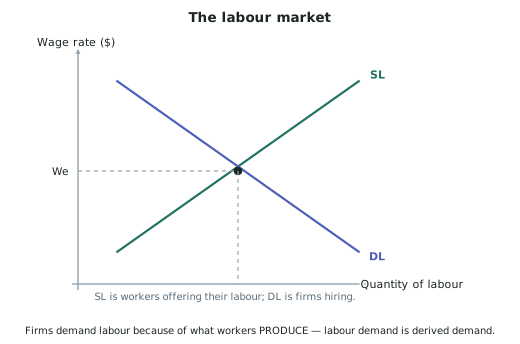
It works like any market — but the "good" being traded is labour, so the axes change.
-
Vertical axis: the wage rate ($) — the price of labour.
-
Horizontal axis: the quantity of labour — usually workers or hours.
-
Demand for labour (DL) slopes down: at a higher wage, firms hire fewer workers.
-
Supply of labour (SL) slopes up: at a higher wage, more people are willing to work.
-
Equilibrium gives the wage We and the quantity of labour employed Le.
Who demands and who supplies
- Firms demand labour. They hire workers because of what those workers produce — labour demand is derived demand, derived from demand for the firm's output.
- Households supply labour. People offer their time in exchange for wages.
What shifts demand for labour
| Event | DL shifts | Effect |
|---|---|---|
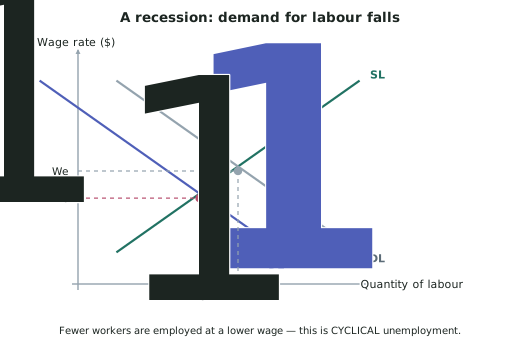
| Aggregate demand falls (recession) | Left | Wage and employment both fall — cyclical unemployment |
| Demand for the industry's product rises | Right | Wage and employment both rise |
| Technology replaces workers | Left | Fewer workers needed for the same output |
| Technology makes workers more productive | Right | Each worker is worth more to the firm |
| Non-wage costs of employing rise | Left | Hiring is more expensive overall |
What shifts supply of labour
| Event | SL shifts | Effect |
|---|---|---|
| Immigration of working-age people | Right | Wage falls, employment rises |
| Population ageing / retirement | Left | Wage rises, employment falls |
| More people gaining relevant skills | Right in that occupation | More qualified workers available |
| Better childcare or transport access | Right | More people able to take work |
| Higher benefit levels relative to wages | Left | Slightly fewer people seeking work at low wages |
A wage floor above equilibrium
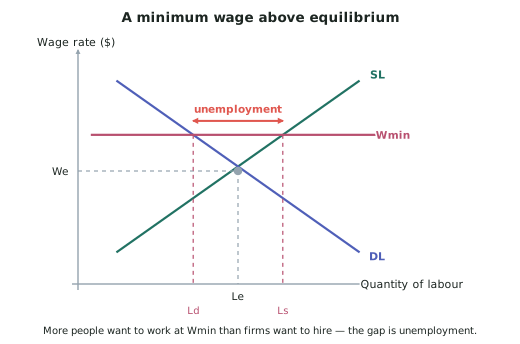
- If a minimum wage (Wmin) is set above the market equilibrium wage:
- Quantity of labour supplied rises — more people want to work at the higher wage.
- Quantity of labour demanded falls — firms hire fewer workers at the higher cost.
- The gap between them is unemployment.
- A minimum wage set below equilibrium has no effect at all — the market wage is already higher, so nothing changes.
- The real-world picture is more complicated than the model. Higher wages can raise workers' spending (raising demand for goods and so for labour), reduce staff turnover, and raise productivity. So the employment effect is usually smaller than the simple model predicts. Say this — it shows you know the model's limits.
Worked ExampleA recession in the labour market
New Zealand enters a recession. Consumer spending falls sharply across the economy.
Explain the impact on the labour market. Refer to the labour market model in your answer, and identify the type of unemployment created.
Step 1 — Start with the product market
Consumer spending falling means aggregate demand falls — households buy fewer goods and services, so firms' sales fall.
Step 2 — Apply derived demand
Firms hire workers because of what those workers produce and sell. Labour demand is derived demand, derived from demand for output.
Because firms are selling less, they need fewer workers to produce it. Their willingness to hire falls at every wage rate.
Step 3 — Shift the curve
Demand for labour shifts left, from DL to DL1.
The supply of labour is unchanged — the same people are available and willing to work; nothing has happened to households' willingness to supply their time.
Step 4 — Read the new equilibrium
DL1 cuts the unchanged SL curve lower and further left:
- The wage rate falls from We to We1
- The quantity of labour employed falls from Le to Le1
Step 5 — Identify the unemployment
The fall from Le to Le1 is the number of workers who had jobs and no longer do. Because the cause is a downturn in the business cycle operating through falling aggregate demand, this is cyclical unemployment.
Step 6 — Add the wider models
- On the AS/AD model: AD shifts left, so real GDP falls from Y to Y1 and the price level falls.
- On the PPF: the economy moves to a point inside the frontier — labour is available but not being used. Productive capacity is unchanged.
Step 7 — Note what happens in practice
In reality wages are sticky downwards — contracts, minimum wage law and reluctance to cut pay mean the wage often does not fall all the way to We1.
If the wage stays near We while demand is at DL1, the fall in employment is larger than the model's new equilibrium suggests, because firms adjust entirely through numbers of workers rather than partly through pay.