Types of involuntary unemployment
Voluntary and involuntary
- Voluntary unemployment — a person chooses not to take work available at the going wage.
- Involuntary unemployment — a person wants work at the going wage and cannot find it.
- The standard names "types of involuntary unemployment" as the examinable concept. Voluntary unemployment is the contrast case, not the object of study.
The five types
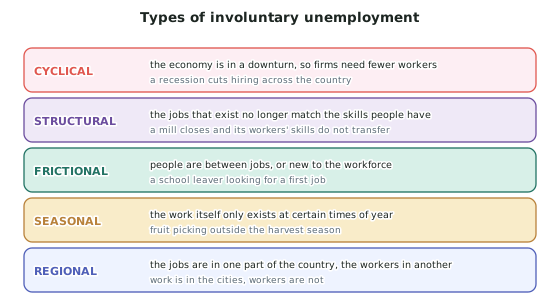
Cyclical unemployment
- Caused by a downturn in the business cycle — aggregate demand falls, so firms need fewer workers.
- Affects the whole economy at once, across many industries.
- Rises in a recession and falls in a recovery.
- The cure is demand: raising AD (a lower OCR, higher government spending) brings these workers back into jobs, because the jobs exist as soon as spending returns.
Structural unemployment
- Caused by a mismatch between the skills people have and the jobs that exist.
- Happens when an industry declines, a technology replaces a task, or production moves overseas.
- Long-lasting, because acquiring new skills takes time — and sometimes the worker's old skills have no other market at all.
- The cure is supply-side: retraining, education, relocation support. Raising AD will not fix it, because the vacancies that exist are ones these workers cannot fill.
Frictional unemployment
- People between jobs, or entering the labour market for the first time.
- Short-term and largely unavoidable — and to a degree useful, because it lets workers and employers find good matches rather than any match.
- Exists even at full employment.
Seasonal unemployment
- The work itself only exists at certain times of year.
- Significant in New Zealand: horticulture outside the harvest, ski fields in summer, tourism in the off-season, freezing works outside the peak.
- Predictable, which makes it easier to plan for than cyclical unemployment.
Regional unemployment
- The jobs are in one part of the country and the workers are in another.
- Persists because moving is costly — housing, family, community ties — and because a declining region's housing may be hard to sell.
- Often overlaps with structural unemployment, since the industries that decline are frequently concentrated in particular regions.
Comparing the types — the Excellence table
| Type | Cause | How long | What fixes it |
|---|---|---|---|
| Cyclical | Weak aggregate demand | As long as the downturn | Demand-side — raise AD |
| Structural | Skills do not match jobs | Years | Supply-side — retraining, education |
| Frictional | Job search takes time | Weeks to months | Better job-matching information |
| Seasonal | Work exists only part of the year | Predictable, annual | Diversifying the local economy |
| Regional | Jobs and workers in different places | Long | Regional development; relocation support |
Why the type matters more than the number
- The same unemployment rate can mean completely different things, and the right policy depends entirely on which type dominates.
- 5% unemployment that is mostly cyclical is a demand problem: it will fall on its own as the economy recovers, and demand policy will speed that up.
- 5% unemployment that is mostly structural is a capacity problem: it will not fall with recovery, and raising demand will simply produce inflation while those workers remain jobless.
Worked ExampleIdentifying and comparing types
In one year, three things happen in New Zealand.
- Event 1: A recession causes firms across the whole economy to reduce staff.
- Event 2: A large processing plant in a small town closes permanently after its owner moves production offshore. It was the town's largest employer.
- Event 3: The kiwifruit harvest ends and thousands of pickers finish work.
Identify the type of unemployment each event causes, and explain which is most serious for New Zealand.
Step 1 — Event 1
Cyclical unemployment.
A recession is a downturn in the business cycle: aggregate demand falls, so firms across every industry see weaker sales and need fewer workers. The defining features are present — it hits the whole economy at once, and it is caused by deficient demand, not by anything about the workers.
On the AS/AD model: AD shifts left, so real GDP falls and firms demand less labour. On the labour market model: demand for labour shifts left, lowering both the wage and the quantity of labour employed. On the PPF: the economy moves to a point inside the frontier.
Step 2 — Event 2
Structural unemployment — and also regional.
The jobs have gone permanently, and the workers' skills were specific to that plant. The vacancies that exist elsewhere in the economy require different skills, so these workers cannot simply fill them. That is the definition of structural unemployment.
It is also regional: the plant was the town's largest employer, so there are no alternative local jobs, and moving is costly — houses in a town that has just lost its main employer are hard to sell.
Step 3 — Event 3
Seasonal unemployment.
The work only exists at certain times of year. Nothing has gone wrong: the harvest has simply finished, exactly as it does every year. It is predictable, and most workers expect it and plan around it.
Step 4 — Which is most serious?
Event 2 — the structural and regional unemployment — is most serious.
Compared with Event 1 (cyclical): cyclical unemployment is temporary and self-reversing. When demand recovers, the jobs come back, and demand-side policy — a lower OCR, higher government spending — can speed that up. The workers still have skills an employer wants; there is simply not enough spending right now. Structural unemployment does not respond to demand policy at all: raising AD creates vacancies these workers cannot fill, so it produces inflation while they remain jobless.
Compared with Event 3 (seasonal): seasonal unemployment is predictable and short. Workers know it is coming and plan for it; many move between seasonal industries. Structural unemployment is unexpected and open-ended.
Why it is worst:
- It lasts years, because retraining takes years and may require relocation.
- It is compounded by being regional — there is nowhere local to go.
- It risks becoming permanent: workers unemployed for long periods lose skills and attachment to the workforce, and the town's remaining businesses lose their customers and close too. What began as a point inside the PPF can become an inward shift of the PPF as capacity is genuinely lost.