Standard reduction potentials
What a reduction potential measures
- Every half reaction has a tendency to pull electrons towards itself. The standard reduction potential, , is a number measuring that tendency.
- It is always quoted for the reduction direction — electrons on the left:
- More positive → the species pulls electrons more strongly → it is a stronger oxidant.
- More negative → it holds its electrons less willingly in the reduced form → the reduced species is a stronger reductant.
Why "standard"
- A potential only has a fixed value under fixed conditions. Standard conditions are:
- Concentration of all solutions 1 mol L−1
- Pressure of any gas 100 kPa
- Temperature 25 °C (298 K)
- Change the conditions and the potential changes. At Level 3 you use the standard values as given and do not adjust them.
Measured against what
- A voltage is always a difference — you cannot measure the potential of one half cell alone.
- So every value is measured against the same reference, the standard hydrogen electrode:
- The zero is a convention, not a measurement. It is the origin everything else is quoted from, which is why the values can be negative.
The table
Listed from strongest oxidant at the top to strongest reductant at the bottom.
| Half reaction (reduction) | / V |
|---|---|
| +2.87 | |
| +1.78 | |
| +1.51 | |
| +1.36 | |
| +1.33 | |
| +1.23 | |
| +1.07 | |
| +0.80 | |
| +0.77 | |
| +0.54 | |
| +0.34 | |
| 0.00 | |
| −0.13 | |
| −0.14 | |
| −0.25 | |
| −0.44 | |
| −0.76 | |
| −0.83 | |
| −1.66 | |
| −2.37 | |
| −2.71 | |
| −3.04 |
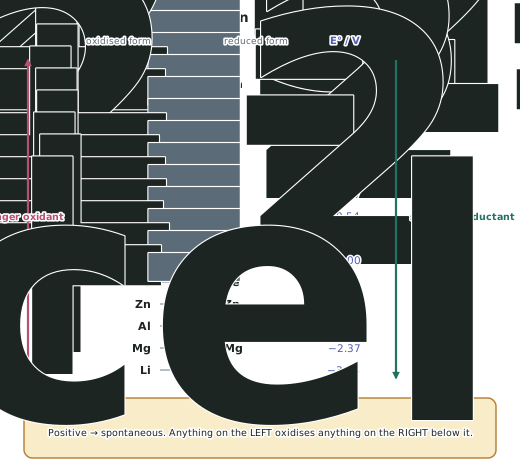
Reading the table
-
The left-hand side of each half reaction is the oxidised form. Going up the table, these become stronger oxidants.
-
The right-hand side is the reduced form. Going down the table, these become stronger reductants.
-
F2 is the strongest oxidant listed; Li is the strongest reductant.
-
A useful check on your understanding: the metals at the bottom of the table are the reactive ones (Li, Na, Mg, Al) and the metals near the top are the unreactive ones (Ag, Cu). The reactivity series is the reduction potential table, read from the reduced side.
does not depend on how many electrons
- If you multiply a half equation to balance electrons, you do not multiply .
- is an intensive property — like temperature or density, it does not depend on how much material there is.
- Reversing a half equation does flip the sign, however:
Worked ExampleRanking oxidants and reductants
Using the table, place the following in order of decreasing strength as oxidants: Fe3+, Cl2, Cu2+, I2. Then state which of the corresponding reduced forms is the strongest reductant, and justify your answers.
Step 1 — Find each half reaction and its
| Half reaction | / V |
|---|---|
| +1.36 | |
| +0.77 | |
| +0.54 | |
| +0.34 |
Step 2 — Order by
An oxidant takes electrons, and a more positive means a stronger pull on electrons — a stronger oxidant.
Cl2 (+1.36) > Fe3+ (+0.77) > I2 (+0.54) > Cu2+ (+0.34)
Step 3 — Identify the strongest reductant
The reduced forms are Cl−, Fe2+, I− and Cu. The reductant strength runs the opposite way: the lower the , the more readily the reduced form gives its electrons up.
The lowest of the four is Cu2+/Cu at +0.34 V, so Cu metal is the strongest reductant of the four reduced forms.
Step 4 — Justify with a prediction
This ordering makes a testable claim: copper should be able to reduce any of the three oxidants above it. Adding copper metal to iron(III) solution should therefore work, and it does — the reaction
is the basis of the ferric chloride used to etch copper from circuit boards.
Answer: oxidant strength Cl2 > Fe3+ > I2 > Cu2+; of the reduced forms, Cu metal is the strongest reductant.