Comparing and contrasting the two cell types
Why this page is the most important one
- The NZQA clarification names comparing and contrasting the oxidation–reduction processes occurring in electrolytic and electrochemical cells as an Excellence requirement.
- Everything in this topic exists to make this comparison possible. If you can do this page properly, you can reach Excellence.
The comparison table
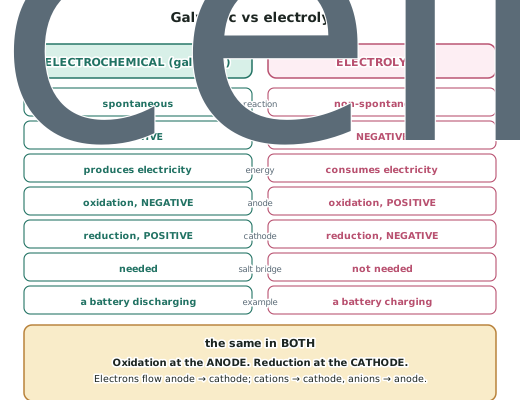
| Electrochemical (galvanic) | Electrolytic | |
|---|---|---|
| Reaction | spontaneous | non-spontaneous |
| positive | negative | |
| Energy | produces electrical energy | consumes electrical energy |
| Power supply | none — the cell is the source | required, and must exceed |
| Anode | oxidation, negative | oxidation, positive |
| Cathode | reduction, positive | reduction, negative |
| Electron flow (external) | anode → cathode | anode → cathode |
| Compartments | usually two, joined by a salt bridge | usually one |
| Salt bridge | needed | not needed |
| Electrolyte | one per half cell, matching each electrode | one, molten or aqueous |
| Examples | batteries, fuel cells, corrosion | electrolysis, electroplating, aluminium smelting |
What is the SAME in both
Getting these right is what makes the contrast meaningful — a comparison that only lists differences misses half the point.
- Oxidation happens at the anode. Reduction happens at the cathode. In both. Always.
- Electrons flow from anode to cathode in the external circuit. In both.
- Cations move towards the cathode; anions move towards the anode, in the solution. In both.
- The half equations look identical — only the direction they are driven differs.
- Charge must balance: electrons lost equal electrons gained. In both.
What is DIFFERENT
- The sign of , and therefore whether energy is produced or consumed. This is the root difference; everything else follows from it.
- The sign of the electrodes. In a galvanic cell the anode is negative because it is the source of electrons; in an electrolytic cell the anode is positive because it is connected to the positive terminal, which pulls electrons out.
- Whether the reaction runs on its own. A galvanic cell runs until equilibrium is reached; an electrolytic cell stops the moment the power is switched off.
- The role of the external circuit. In a galvanic cell the circuit is where the useful work is done. In an electrolytic cell it is where the energy is supplied.
The relationship between them
-
They are the same reaction run in opposite directions.
-
The clearest illustration is a rechargeable battery:
- Discharging — it is an electrochemical cell. is positive, the reaction is spontaneous, and electrical energy is delivered.
- Charging — it is an electrolytic cell. The external charger forces the reaction backwards against a negative , consuming energy.
- The same electrode is the anode in one mode and the cathode in the other, which is why battery terminals are labelled + and − rather than anode and cathode.
-
This single example contains the whole comparison and is worth building an Excellence answer around.
How to write the comparison
- Do not just list differences. State a point of similarity, then the corresponding difference, then why they differ.
- Anchor every point in chemistry. "The anode is positive in one and negative in the other" is a fact; "the anode is negative in a galvanic cell because it is the source of the electrons that flow into the circuit, and positive in an electrolytic cell because it is connected to the terminal that removes electrons" is a comparison.
- Support with equations, a calculation and an observation — the criteria name all three, and a comparison carrying all three is a strong Excellence answer.
Worked ExampleA full compare-and-contrast answer
Compare and contrast the oxidation–reduction processes occurring in an electrochemical cell and an electrolytic cell, using the zinc–copper cell and the electrolysis of molten sodium chloride as examples. Support your answer with half equations, calculations and observations.
The two systems
Electrochemical: the zinc–copper cell
- Anode: , V
- Cathode: , V
Electrolytic: molten sodium chloride
- Anode: , V
- Cathode: , V
What is the same
The location of each process is identical. In both cells, oxidation occurs at the anode and reduction occurs at the cathode. This is definitional, not coincidental — the terms are defined by the chemistry.
The direction of electron flow is identical. Electrons leave the species being oxidised at the anode, travel through the external circuit, and arrive at the species being reduced at the cathode. In the zinc–copper cell they flow from zinc to copper; in the electrolysis they flow from the chloride-oxidising anode to the sodium-reducing cathode.
The ion movement is identical. Cations migrate towards the cathode (Cu2+ towards the copper electrode; Na+ towards the cathode in the melt), and anions towards the anode.
The electron bookkeeping is identical. In both, electrons lost equal electrons gained, which is why half equations must be multiplied to match before combining.
What is different, and why
The sign of , which is the root difference. +1.10 V against −4.07 V. Everything else follows from this one fact.
Whether energy is produced or consumed. The positive of the zinc–copper cell means the reaction is spontaneous and releases energy, which can be drawn off as electrical work. The negative of the sodium chloride electrolysis means the reaction cannot occur on its own; a power supply delivering more than 4.07 V is required to force it, and it stops instantly if that supply is disconnected.
The sign of the electrodes, and the reason for it. In the galvanic cell the anode is negative, because it is the source of the electrons entering the circuit — electrons pile up there as zinc dissolves. In the electrolytic cell the anode is positive, because it is connected to the positive terminal, which pulls electrons out of the chloride ions. In both cases oxidation happens there; only what drives the electron removal differs.
The role of the external circuit. In the galvanic cell the circuit is where the useful work is extracted — the electrons do work on their way from zinc to copper. In the electrolytic cell the circuit is where the energy is put in.
The physical construction. The galvanic cell needs two separate compartments and a salt bridge, because letting Zn and Cu2+ touch would allow the electrons to transfer directly and release the energy as heat instead. The electrolytic cell needs only one compartment, since the reaction will not occur spontaneously even with the reactants in contact.
Observations, contrasted
Zinc–copper cell: the zinc electrode dissolves and loses mass; pink-brown copper deposits on the cathode; the blue colour fades as Cu2+ is consumed; the voltmeter reads about 1.10 V and falls gradually.
Sodium chloride electrolysis: silvery molten sodium collects at the cathode; pale yellow-green chlorine gas with a choking smell bubbles off at the anode; nothing happens at all when the power is disconnected.
That last contrast is the most revealing observation of the pair: one cell runs until its chemistry is exhausted, and the other stops the instant the energy supply is removed.
The unifying point
These are not two kinds of chemistry but one kind of chemistry driven in two directions. A rechargeable battery makes this explicit: discharging, it is an electrochemical cell with a positive delivering energy; charging, it is an electrolytic cell with a negative consuming it. The same physical electrode is the anode in one mode and the cathode in the other — which is precisely why battery terminals are marked + and − rather than anode and cathode.
Answer: both cells site oxidation at the anode and reduction at the cathode with electrons flowing anode to cathode; they differ in the sign of E°cell, and therefore in whether energy is produced or consumed, which in turn determines the electrode polarity and whether the reaction proceeds without an external supply.