Electrolytic cells
The idea
-
An electrolytic cell does the opposite of a galvanic cell: it uses an external power supply to force a non-spontaneous redox reaction to happen.
-
The reaction has a negative , so it will not go on its own. The power supply pushes electrons the wrong way round, and the applied voltage must exceed the magnitude of that negative .
-
Electricity is consumed, not produced. That energy requirement is the defining feature, and the criteria name it: at every grade you must refer to the energy input an electrolytic cell requires.
The parts
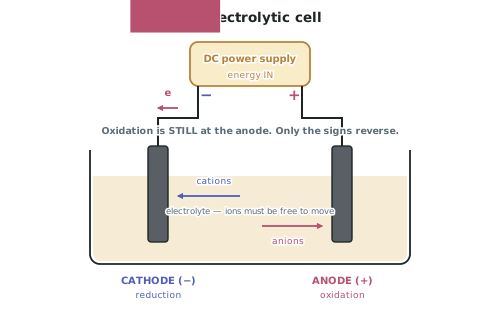
| Part | What it does |
|---|---|
| Power supply | forces electrons from the anode to the cathode, against the spontaneous direction |
| Anode (+) | oxidation — connected to the positive terminal, so it pulls electrons out of the anions |
| Cathode (−) | reduction — connected to the negative terminal, so it pushes electrons into the cations |
| Electrolyte | a molten ionic compound or an aqueous solution — ions must be free to move |
- Oxidation is still at the anode and reduction still at the cathode. Only the signs are reversed, because in this cell the electrodes are driven by an external supply rather than driving one.
Electrolysis of a molten salt
The simplest case, because only the salt's own ions are present.
Molten sodium chloride:
-
Cathode (−):
-
Anode (+):
-
Overall:
-
V, strongly negative — which is why this needs a substantial applied voltage and a furnace at over 800 °C.
-
Observations: molten sodium metal collects at the cathode; pale yellow-green chlorine gas bubbles off at the anode.
Electrolysis of an aqueous solution
- Water is present, and water can be both oxidised and reduced. So at each electrode there is a competition, and decides the winner.
At the cathode, the competitors are the metal cation and water:
- The species with the more positive is reduced.
- Cu2+ (+0.34 V) beats water → copper metal is deposited.
- Na+ (−2.71 V) loses to water → hydrogen is produced, not sodium.
At the anode, the competitors are the anion and water:
-
The species with the less positive is oxidised (it gives up electrons more readily).
- SO42− is very hard to oxidise → oxygen from water is produced.
- Br− (+1.07 V) beats water → bromine is produced.
-
The general result: reactive metals cannot be extracted from aqueous solution, because water is reduced in preference. Sodium, magnesium and aluminium must be electrolysed from molten compounds.
Electrolysis of brine
-
Concentrated sodium chloride solution is industrially important, producing three useful products at once.
-
Cathode (−):
- Water beats Na+, because −0.83 V is far more positive than −2.71 V.
-
Anode (+):
- On alone, water at +1.23 V should be oxidised in preference to chloride at +1.36 V — but in concentrated brine, chlorine is produced. Two factors override the standard prediction: the very high chloride concentration, which is far from the standard 1 mol L−1, and the fact that oxygen evolution at the electrode surface is kinetically hindered.
-
In solution: Na+ and OH− remain, so sodium hydroxide is the third product.
-
Observations: colourless gas bubbles at the cathode (H2, which burns with a squeaky pop); pale yellow-green gas with a choking smell at the anode (Cl2, which bleaches damp litmus); the solution around the cathode turns the indicator purple, showing OH−.
-
This is a valuable case for the standard because it is a documented example of predicting one product and observation showing another — exactly the kind of link between calculation and observation the criteria ask for.
Electroplating
- Electroplating deposits a thin layer of metal onto an object, for appearance or corrosion protection.
- The setup:
- Cathode: the object to be plated — reduction deposits metal onto it.
- Anode: the plating metal — it dissolves, replenishing the solution.
- Electrolyte: a solution of the plating metal's ions.
For silver-plating a spoon:
-
Cathode (spoon):
-
Anode (silver bar):
-
The overall chemical change is nothing — silver is simply transported from the anode to the cathode. for the pure transfer, so only a small voltage is needed to overcome resistance.
-
The object must be the cathode. Reduction deposits metal, and reduction happens at the cathode.
Electrolysis in New Zealand
- Tiwai Point near Bluff smelts aluminium by electrolysis of Al2O3 dissolved in molten cryolite. Aluminium's of −1.66 V makes it impossible to obtain from aqueous solution or by carbon reduction, so electrolysis is the only route.
- The smelter consumes around 13% of New Zealand's total electricity, supplied by the Manapōuri power station. The chemistry decides the geography: an electrolytic process must be sited where electricity is cheap and abundant.
Worked ExamplePredicting the products of an aqueous electrolysis
Predict the products of the electrolysis of aqueous copper(II) sulfate using inert graphite electrodes. Write the half equations, calculate E°cell, and describe what would be observed.
, V , V , V
Step 1 — Identify the competitors at the cathode
The cathode reduces something. The candidates are Cu2+ and water.
| Candidate | / V |
|---|---|
| Cu2+ | +0.34 |
| H2O | −0.83 |
The species with the more positive is reduced more easily. Cu2+ wins.
Step 2 — Identify the competitors at the anode
The anode oxidises something. The candidates are SO42− and water.
Sulfate contains sulfur already in its highest oxidation state, +6, so it cannot easily be oxidised further — there is no accessible half reaction for it. Water is oxidised.
Step 3 — Combine and calculate
Multiply the cathode reaction by 2 so both involve four electrons:
Step 4 — Interpret the sign
is negative, confirming the reaction is not spontaneous. An external power supply delivering more than 0.89 V is required to drive it — which is exactly what makes this an electrolytic and not a galvanic cell.
Step 5 — Describe the observations
- A pink-brown coating of copper builds up on the cathode, which gains mass.
- Bubbles of colourless gas appear at the anode; the gas relights a glowing splint, identifying it as oxygen.
- The blue colour of the solution fades as Cu2+ is removed.
- The solution becomes acidic, because H+ ions are produced at the anode — universal indicator would turn red near that electrode.
Answer: copper is deposited at the cathode and oxygen evolved at the anode; E°cell = −0.89 V, so at least 0.89 V must be supplied.