Electrochemical (galvanic) cells
The idea
-
A spontaneous redox reaction releases energy. If the two half reactions happen in the same beaker, that energy is released as heat and is wasted.
-
Separate them into two half cells and connect them with a wire, and the electrons must travel through the wire to get from the reductant to the oxidant. That flow of electrons is an electric current.
-
An electrochemical cell is a spontaneous redox reaction with the two halves physically separated so the electrons have to do work on the way.
The parts
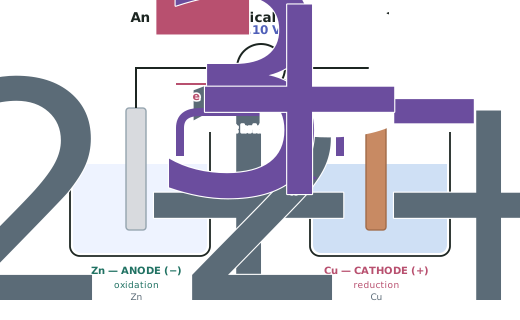
| Part | What it does |
|---|---|
| Anode | where oxidation happens; the negative electrode in a galvanic cell |
| Cathode | where reduction happens; the positive electrode in a galvanic cell |
| External circuit | carries electrons from anode to cathode |
| Salt bridge | carries ions between the half cells, completing the circuit and keeping both solutions neutral |
| Voltmeter | measures the cell potential |
- Two memory aids that work: AN OX (ANode = OXidation) and RED CAT (REDuction = CAThode). These hold for both kinds of cell, which is why they are worth learning rather than memorising which electrode is positive.
Which electrode is which
- The electrode of the more negative is the anode, and it is oxidised.
- The electrode of the more positive is the cathode, and it is reduced.
- Electrons always flow from anode to cathode through the wire.
For a zinc–copper cell:
- Anode (−): , V
- Cathode (+): , V
- Overall:
- V
Why the salt bridge is essential
-
Without it, the cell stops almost immediately. Here is why:
- As zinc dissolves, the anode compartment accumulates positive Zn2+ ions.
- As Cu2+ is deposited, the cathode compartment is left with excess negative SO42− ions.
- A build-up of charge opposes further electron flow, and the current stops.
-
The salt bridge — a tube of inert electrolyte such as KNO3 — lets ions move to cancel this build-up:
- Anions move towards the anode (towards the building positive charge).
- Cations move towards the cathode.
-
The electrolyte in the bridge must be inert: its ions must not react with, or precipitate, anything in either half cell. This is why KNO3 is used — all potassium and all nitrate salts are soluble.
Observations in a working cell
The criteria require observations, so know what a running zinc–copper cell looks like:
- The zinc electrode loses mass and becomes pitted as it dissolves.
- The copper electrode gains mass as copper is deposited on it.
- The blue colour of the copper sulfate solution fades as Cu2+ is consumed.
- The voltmeter reads about 1.10 V at standard conditions, and the reading falls over time as the concentrations move away from standard.
Cell notation
- A cell is written compactly, anode on the left:
- A single line | is a phase boundary; a double line ‖ is the salt bridge.
- If both species of a couple are in solution — such as Fe3+/Fe2+ — an inert electrode of platinum or graphite is needed to make electrical contact, and it appears at the end:
Worked ExampleDesigning and describing a galvanic cell
A cell is constructed from a nickel electrode in 1 mol L−1 nickel(II) sulfate and a silver electrode in 1 mol L−1 silver nitrate, joined by a potassium nitrate salt bridge.
Identify the anode and cathode, write the half equations and overall equation, calculate E°cell, and describe what would be observed.
, V , V
Step 1 — Identify the electrodes
The more negative is oxidised at the anode. Nickel at −0.25 V is more negative than silver at +0.80 V.
- Anode (negative): nickel
- Cathode (positive): silver
Step 2 — Write the half equations
Anode, oxidation:
Cathode, reduction:
Step 3 — Balance the electrons and combine
The silver half equation must be doubled so both involve two electrons — but is not doubled:
Adding and cancelling the electrons:
Step 4 — Calculate
Positive, confirming the reaction is spontaneous and the cell will deliver current.
Step 5 — Describe the observations
- The nickel electrode dissolves, losing mass and becoming pitted.
- The nickel half cell's solution becomes more intensely green, as the concentration of Ni2+ rises.
- Silver crystals deposit on the silver electrode, which gains mass.
- The colourless silver nitrate solution becomes less concentrated in Ag+, though it stays colourless.
- The voltmeter reads about 1.05 V, falling slowly as the cell operates.
Step 6 — Ion movement
In the external circuit, electrons flow from the nickel anode to the silver cathode.
In the salt bridge, nitrate ions move towards the nickel half cell to balance the accumulating Ni2+, and potassium ions move towards the silver half cell to replace the Ag+ removed.
Answer: nickel is the anode (oxidised) and silver the cathode (reduced); E°cell = +1.05 V.