Solubility rules and predicting precipitates
Why solubility rules are the engine of the whole procedure
- Every precipitation test works the same way: you add an ion that will form an insoluble compound with the ion you are looking for.
- If you know which combinations are insoluble, you can predict every test in the procedure and explain why it works — which is what separates Excellence from a lookup.
The rules
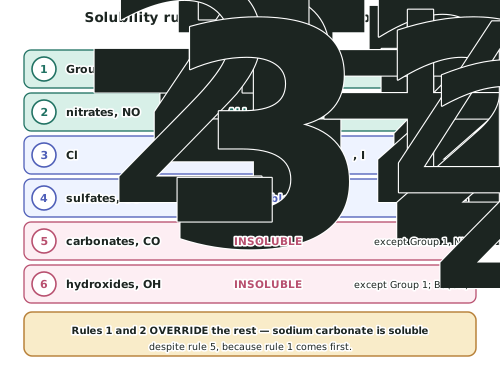
Learn these in this order. Rules higher in the list override rules lower down.
| Rule | Soluble | Exceptions (insoluble) |
|---|---|---|
| 1. Group 1 ions (Na+, K+, Li+) and ammonium (NH4+) | all soluble | none |
| 2. Nitrates (NO3−) | all soluble | none |
| 3. Chlorides, bromides, iodides | soluble | Ag+, Pb2+ |
| 4. Sulfates (SO42−) | soluble | Ba2+, Pb2+, Ca2+ (slightly) |
| 5. Carbonates (CO32−) | insoluble | Group 1 and NH4+ |
| 6. Hydroxides (OH−) | insoluble | Group 1; Ba(OH)2 soluble, Ca(OH)2 slightly |
- Rules 1 and 2 are the overriding ones: sodium carbonate is soluble despite rule 5, because rule 1 comes first.
Using the rules to predict a precipitate
- Write the ions present in both solutions being mixed.
- Pair them the other way round — each cation with the other anion.
- Check each new pair against the rules.
- Any pair that is insoluble is the precipitate.
For example, mixing barium chloride and sodium sulfate solutions:
- Ions present: Ba2+, Cl−, Na+, SO42−.
- New pairings: BaSO4 and NaCl.
- Rule 4 says sulfates are soluble except barium — so BaSO4 precipitates.
- Rule 1 says sodium salts are all soluble — so NaCl stays in solution.
Writing the ionic equation
- The ionic equation shows only the ions that actually change. Spectator ions are left out.
- Include state symbols: this is the only way the equation shows that a precipitate formed.
- Never write the sodium or chloride ions in this equation. They were in solution before and are in solution after, so they are spectators.
- Getting the charges balanced matters: is 1 : 1, but needs two chlorides.
The colours of the common precipitates
Colour is what distinguishes one precipitate from another, so this table is the heart of the identification.
| Precipitate | Colour |
|---|---|
| AgCl | white (darkens to grey/purple in light) |
| AgBr | cream |
| AgI | yellow |
| BaSO4, PbSO4, CaSO4 | white |
| CaCO3, most carbonates | white |
| CuCO3 | blue-green |
| Cu(OH)2 | pale blue |
| Fe(OH)2 | green |
| Fe(OH)3 | red-brown |
| Al(OH)3, Zn(OH)2, Mg(OH)2, Ca(OH)2 | white |
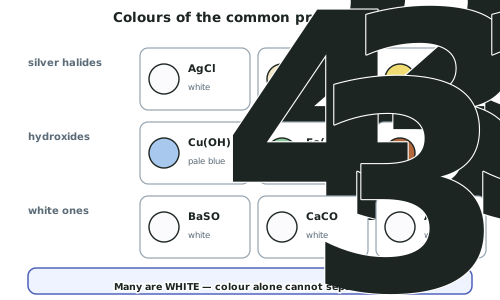
- Notice how many are white. Colour alone will identify Cu2+ or Fe3+, but it can never distinguish Al3+ from Zn2+ from Mg2+ — which is why the next page's complex ion tests exist.
Worked ExamplePredicting and explaining a precipitate
A colourless solution of lead(II) nitrate is added to a colourless solution of potassium iodide. A bright yellow precipitate forms. Use the solubility rules to explain the observation and write the ionic equation.
Step 1 — List the ions present before mixing
From lead(II) nitrate: Pb2+ and NO3−.
From potassium iodide: K+ and I−.
Both solutions are colourless, and all four ions are in solution — consistent with rule 2 (all nitrates soluble) and rule 1 (all potassium salts soluble).
Step 2 — Pair the ions the other way round
The two possible new compounds are PbI2 and KNO3.
Step 3 — Check each against the rules
- KNO3 — rule 1 says all Group 1 salts are soluble, and rule 2 says all nitrates are soluble. Both rules agree: soluble. It stays in solution.
- PbI2 — rule 3 says chlorides, bromides and iodides are soluble except those of Ag+ and Pb2+. Lead is named as the exception, so PbI2 is insoluble and precipitates.
Step 4 — Write the ionic equation
Only the ions that change are included. The K+ and NO3− ions are spectators.
Check the charges: left is ; right is a neutral solid, 0. Balanced.
Note the two iodide ions, required because lead is 2+ and iodide is only 1−.
Step 5 — Confirm against the colour data
The precipitate colour table gives lead(II) iodide as bright yellow, which matches the observation. Yellow is a distinctive colour among the common precipitates — the only other yellow one at this level is AgI — so the observation supports the identification strongly.
Answer: Pb2+(aq) + 2I−(aq) → PbI2(s). Lead iodide is one of the named exceptions to the rule that iodides are soluble, and its bright yellow colour matches the observation.