Identifying organic compounds by functional group
The other route through this standard
-
Explanatory Note 3 allows the identification procedure to be based on functional group reactions instead of ions.
-
The chemistry is the Level 2 organic chemistry from AS91165: alkanes, alkenes, alkynes, haloalkanes, primary amines, alcohols and carboxylic acids.
-
The logic is identical to the ion route: a reagent gives a visible change with one functional group and not with others, so a pattern of results identifies the compound.
The tests
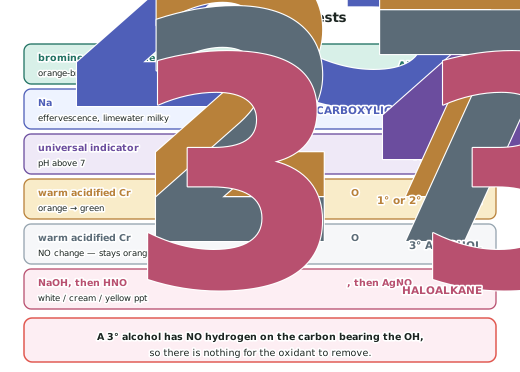
| Functional group | Reagent | Positive observation |
|---|---|---|
| Alkene (C=C) | bromine water | orange-brown decolourises immediately, without light |
| Alkene | acidified MnO4− | purple decolourises |
| Alkane | bromine water | no change in the dark; slow in sunlight |
| Carboxylic acid (−COOH) | sodium carbonate | effervescence; gas turns limewater milky |
| Carboxylic acid | universal indicator | pH below 7 |
| Primary amine (−NH2) | universal indicator | pH above 7 |
| 1° alcohol | acidified Cr2O72−, warmed | orange → green |
| 2° alcohol | acidified Cr2O72−, warmed | orange → green |
| 3° alcohol | acidified Cr2O72−, warmed | no change — stays orange |
| Haloalkane | warm with NaOH(aq), acidify with HNO3, add AgNO3 | precipitate: white (Cl), cream (Br), yellow (I) |
Alkenes with bromine water
- Bromine adds across the double bond, so the orange-brown colour disappears:
- The product is colourless, which is why the colour is lost.
- An alkane gives no reaction in the dark, because it has no double bond and substitution requires UV light. This contrast is what makes the test discriminating.
Carboxylic acids with carbonate
- Carboxylic acids are strong enough acids to react with carbonate, releasing CO2:
- Alcohols do not react with carbonate, so this test cleanly separates the two oxygen-containing families that a student might otherwise confuse.
Alcohols with dichromate
- Primary alcohols are oxidised to carboxylic acids; secondary alcohols to ketones; tertiary alcohols are not oxidised at all.
- Whenever oxidation happens, the dichromate is reduced and the colour goes orange to green:
- A tertiary alcohol has no hydrogen atom on the carbon bearing the OH group, so there is nothing for the oxidant to remove — the solution stays orange. That structural reason is the explanation the criteria want, not just the observation.
Haloalkanes — a two-stage test
- The halogen in a haloalkane is covalently bonded, so it is not a free halide ion and will not precipitate with silver nitrate directly.
- It must be released first, by warming with aqueous sodium hydroxide:
- Then acidify with dilute nitric acid — essential, because the excess NaOH would otherwise precipitate silver hydroxide — and add silver nitrate:
- The precipitate colour identifies which halogen was present, exactly as in the anion tests.
Writing structural formulae
- The clarification specifically requires structural formulae for organic compounds in your equations.
- Do not write molecular formulae like C2H6O — that could be ethanol or methoxymethane, which is precisely the ambiguity the test was designed to remove.
- Write CH3CH2OH, showing the functional group explicitly.
Worked ExampleIdentifying an unknown organic liquid
A colourless organic liquid is tested. It does not decolourise bromine water in the dark. It has no effect on universal indicator, which stays green. When warmed with acidified potassium dichromate solution, the orange colour turns green. Identify the functional group present, state what the compound cannot be, and write equations for the changes observed.
Step 1 — What the bromine water result eliminates
No decolourisation in the dark means there is no C=C double bond. The compound is not an alkene (and not an alkyne).
Step 2 — What the indicator result eliminates
Universal indicator staying green means the solution is neutral, pH about 7.
- A carboxylic acid would give a pH below 7. Eliminated.
- A primary amine would give a pH above 7. Eliminated.
Step 3 — What the dichromate result shows
Orange turning green means the dichromate has been reduced to Cr3+, so something in the sample was oxidised.
Of the remaining families, the one that is oxidised by acidified dichromate is an alcohol.
Step 4 — Narrow down which alcohol
A tertiary alcohol would not be oxidised, because the carbon bearing the −OH group carries no hydrogen atom for the oxidant to remove — the solution would have stayed orange.
Since the colour changed, the compound is a primary or secondary alcohol. This test cannot separate those two, since both give the same colour change.
Step 5 — Equations
Oxidation of a primary alcohol (using ethanol as the example), which proceeds to the carboxylic acid:
Reduction of the dichromate, which is the source of the colour change:
Step 6 — How to distinguish primary from secondary
To take the identification further, test the oxidation product: a primary alcohol yields a carboxylic acid, which would give effervescence with sodium carbonate; a secondary alcohol yields a ketone, which would not.
Answer: the compound contains an alcohol (−OH) functional group and is a primary or secondary alcohol. It is not an alkene (no decolourisation of bromine water), not a carboxylic acid or amine (neutral pH), and not a tertiary alcohol (it was oxidised).