Identifying anions
The four anions you will meet
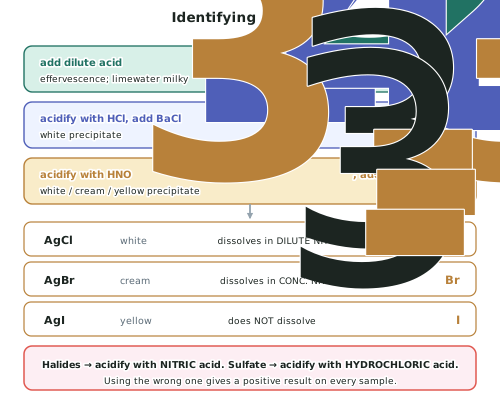
At Level 2 the anion tests cover carbonate, sulfate, the halides, and hydroxide. Each has a specific reagent and a specific observation.
| Anion | Reagent | Observation |
|---|---|---|
| CO32− | dilute acid | effervescence; gas turns limewater milky |
| SO42− | acidify with HCl, then BaCl2 | white precipitate |
| Cl− | acidify with HNO3, then AgNO3 | white precipitate, dissolves in dilute NH3 |
| Br− | acidify with HNO3, then AgNO3 | cream precipitate, dissolves in concentrated NH3 only |
| I− | acidify with HNO3, then AgNO3 | yellow precipitate, insoluble in NH3 |
| OH− | red litmus / universal indicator | litmus turns blue; pH above 7 |
Carbonate
- Add dilute acid — the carbonate is destroyed and carbon dioxide is released:
- Confirm the gas by bubbling it through limewater, which turns milky as insoluble calcium carbonate forms:
- Effervescence alone is not conclusive — it only shows a gas was produced. The limewater test is what identifies the gas as CO2, and reporting the confirmation is what makes the identification secure.
Sulfate
- Acidify first with dilute hydrochloric acid, to destroy any carbonate that would also give a white precipitate.
- Then add barium chloride solution:
- The precipitate is white and does not dissolve in acid, because sulfate is the conjugate base of a strong acid and is not protonated.
The halides
- Acidify first with dilute nitric acid — never hydrochloric, which would add chloride ions and give a false positive.
- Then add silver nitrate solution:
- The three colours form a continuum, and distinguishing cream from pale yellow by eye is genuinely difficult — which is why the ammonia step exists.
The ammonia confirmation for halides
- Add ammonia solution to the precipitate. The differences in solubility are large and unambiguous:
| Precipitate | Dilute NH3 | Concentrated NH3 |
|---|---|---|
| AgCl | dissolves | dissolves |
| AgBr | stays | dissolves |
| AgI | stays | stays |
- The chloride dissolves because silver forms a soluble diamminesilver(I) complex:
-
The trend follows the insolubility of the three silver halides: AgCl is the least insoluble, AgI the most, so it takes a progressively higher ammonia concentration to pull the silver away — and with AgI, no attainable concentration is enough.
-
One more diagnostic: AgCl darkens from white to grey or purple on standing in light, as it decomposes to silver metal. If your white precipitate greys over a few minutes, that is a further confirmation of chloride.
Worked ExampleIdentifying both species in a sample
A colourless solution is tested. Adding dilute nitric acid produces no effervescence. Adding silver nitrate to the acidified solution gives a cream precipitate which does not dissolve in dilute ammonia but dissolves in concentrated ammonia. A separate portion, tested with sodium hydroxide, gives a white precipitate which does not dissolve in excess sodium hydroxide or in excess ammonia, and the solution is known not to contain calcium. Identify the compound present and write equations for all the changes.
Step 1 — What the acid test shows
No effervescence with dilute acid means no carbonate is present. This is a negative result, and it is genuine evidence — it eliminates a whole class of compounds.
Step 2 — Identify the anion
A cream precipitate with silver nitrate points to AgBr, but cream and pale yellow are hard to distinguish by eye, so the ammonia tests are decisive:
- Did not dissolve in dilute ammonia — eliminates chloride, since AgCl dissolves readily in dilute ammonia.
- Dissolved in concentrated ammonia — eliminates iodide, since AgI is too insoluble to dissolve in ammonia at any concentration.
The anion is Br−.
Step 3 — Identify the cation
A white precipitate with hydroxide eliminates Cu2+, Fe2+ and Fe3+.
No dissolution in excess NaOH eliminates the amphoteric ions Al3+ and Zn2+.
No dissolution in excess ammonia confirms it is not Zn2+.
That leaves Mg2+ and Ca2+, and the question states calcium is absent. The cation is Mg2+.
(In practice these two are separated by the fact that Ca(OH)2 is only slightly insoluble, so calcium often gives a faint cloudiness rather than a definite precipitate.)
Step 4 — Name the compound
Combining a 2+ cation with a 1− anion requires two bromide ions per magnesium:
Magnesium bromide, MgBr2.
Step 5 — Equations for all the changes
Precipitation of the silver halide:
Dissolution in concentrated ammonia:
Precipitation of the metal hydroxide:
Answer: the sample contains magnesium bromide, MgBr2 — Mg2+ identified by a white hydroxide precipitate insoluble in both excess reagents, and Br− identified by a cream silver precipitate soluble only in concentrated ammonia.