Complex ions and identifying cations
The problem colours alone cannot solve
- Adding hydroxide to a solution of Al3+, Zn2+, Mg2+ or Ca2+ gives a white precipitate every time.
- The colours are identical, so colour cannot distinguish them. What distinguishes them is what happens when you add more reagent.
What a complex ion is
- A complex ion forms when a metal ion bonds to several small molecules or ions called ligands.
- The ligand supplies a lone pair of electrons to form a bond with the metal ion.
- Because the complex ion is soluble, a precipitate that can form a complex ion will redissolve when excess reagent is added.
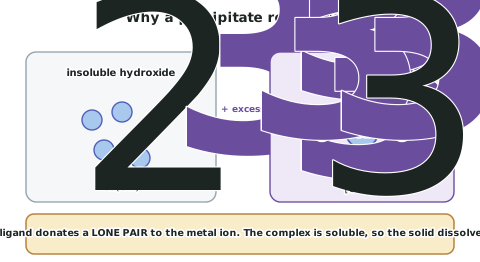
- This redissolution is the whole basis of the cation identification scheme: precipitate, then see whether excess reagent dissolves it.
The two reagents and what they do
You add two reagents to separate portions of the sample, and the pattern of results identifies the cation.
| Cation | Add NaOH dropwise | Add NaOH in excess | Add NH3 in excess |
|---|---|---|---|
| Cu2+ | pale blue ppt | stays | dissolves → deep blue solution |
| Fe2+ | green ppt | stays | stays |
| Fe3+ | red-brown ppt | stays | stays |
| Al3+ | white ppt | dissolves → colourless | stays |
| Zn2+ | white ppt | dissolves → colourless | dissolves → colourless |
| Mg2+ | white ppt | stays | stays |
| Ca2+ | white ppt or faint cloudiness | stays | stays |
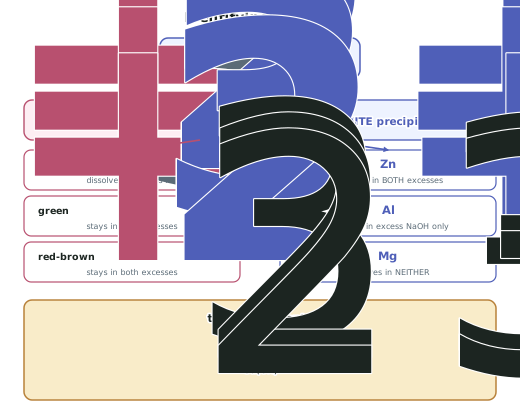
- Read the table down the excess columns and the logic becomes obvious:
- Dissolves in both excesses → Zn2+.
- Dissolves in NaOH only → Al3+.
- Dissolves in NH3 only → Cu2+ (and the deep blue confirms it).
- Dissolves in neither, white → Mg2+ or Ca2+.
- Dissolves in neither, coloured → Fe2+ (green) or Fe3+ (red-brown).
An unknown solution contains one cation. Add reagents to identify it.
Identify the cation:
Run at least one test first.
Amphoteric hydroxides
- Amphoteric means reacting with both acids and bases.
- Al(OH)3 and Zn(OH)2 are amphoteric, which is why excess NaOH dissolves them: the extra hydroxide acts as a base and converts the solid into a soluble hydroxo complex.
- Mg(OH)2 and Fe(OH)3 are not amphoteric, so no amount of extra NaOH will dissolve them.
Ammine complexes
- Ammonia acts as a ligand, donating the lone pair on its nitrogen atom to the metal ion.
- Only some metal ions form ammine complexes, which is what makes the ammonia test discriminating.
- The deep blue colour of is one of the most distinctive observations in the whole scheme — nothing else at Level 2 produces it.
Why ammonia gives a precipitate first
- Ammonia is a weak base, so it produces a low concentration of hydroxide ions in water:
- Those hydroxide ions precipitate the metal hydroxide first. Only once excess ammonia is present does the complex ion form and the precipitate dissolve.
- This is why the procedure says to add ammonia dropwise first, then in excess — the two stages give two separate pieces of information.
Testing for the ammonium ion
- NH4+ is the one cation that is not identified by precipitation, because all ammonium salts are soluble.
- Instead, warm the sample with sodium hydroxide and test the gas:
- Ammonia gas turns damp red litmus blue and has a sharp, distinctive smell.
Worked ExampleIdentifying an unknown cation
A colourless solution is divided into two portions. To the first, sodium hydroxide solution is added dropwise, giving a white precipitate which dissolves when excess sodium hydroxide is added. To the second, ammonia solution is added dropwise, giving a white precipitate which does not dissolve in excess ammonia. Identify the cation and write equations for all the changes.
Step 1 — What the first observation eliminates
A white precipitate with hydroxide rules out the coloured ions immediately: Cu2+ (pale blue), Fe2+ (green) and Fe3+ (red-brown) are all excluded.
The remaining candidates are Al3+, Zn2+, Mg2+ and Ca2+.
Step 2 — What dissolving in excess NaOH tells you
Dissolving in excess sodium hydroxide means the hydroxide is amphoteric. Only Al(OH)3 and Zn(OH)2 are amphoteric at this level.
Mg2+ and Ca2+ are now eliminated. Two candidates remain: Al3+ and Zn2+.
Step 3 — What the ammonia result tells you
The precipitate did not dissolve in excess ammonia.
- Zn2+ forms the soluble tetraamminezinc complex, so a zinc precipitate would have dissolved.
- Al3+ does not form an ammine complex, so aluminium hydroxide stays.
Zinc is eliminated. The cation is Al3+.
Step 4 — Write equations for all three changes
Precipitation with hydroxide (from either reagent):
Dissolution in excess sodium hydroxide, forming the hydroxo complex:
Ammonia acting as a weak base to supply the hydroxide in the second portion:
Step 5 — Justify with the chemical principle
The identification rests on a real chemical difference, not just a table: Al(OH)3 is amphoteric but does not form an ammine complex, whereas Zn(OH)2 is amphoteric and forms an ammine complex. Testing with both reagents separates them, and no single test could have.
Answer: the cation is Al3+.