The chemistry of sunscreen
Why this technology matters in New Zealand
- New Zealand has among the highest melanoma rates in the world, and one of the highest peak UV indexes of any populated country.
- Three chemical and physical facts combine to cause this:
- The ozone layer is thinner over the Southern Hemisphere in spring, so less UV-B is absorbed on the way down.
- Earth is closest to the Sun in the southern summer, so the incoming radiation is a few percent more intense.
- New Zealand's air carries less industrial aerosol than equivalent Northern Hemisphere latitudes, so less UV is scattered away.
- This makes sunscreen an unusually well-motivated technology to study from a New Zealand perspective.
What sunscreen has to do, chemically
- Ultraviolet radiation is electromagnetic radiation of shorter wavelength — and therefore higher energy — than visible light.
| Band | Wavelength | What it does |
|---|---|---|
| UV-A | 315–400 nm | penetrates deep into skin; causes ageing and contributes to cancer |
| UV-B | 280–315 nm | absorbed in the upper skin layers; causes sunburn and DNA damage |
| UV-C | 100–280 nm | absorbed entirely by the ozone layer; never reaches the ground |
- The damage is chemical: UV photons carry enough energy to break covalent bonds in DNA, forming abnormal links between adjacent bases. If the cell repairs this wrongly, the mutation can lead to cancer.
- A sunscreen must therefore intercept the photon before it reaches the DNA — either by absorbing it or by scattering it.
Organic filters — absorbing the energy
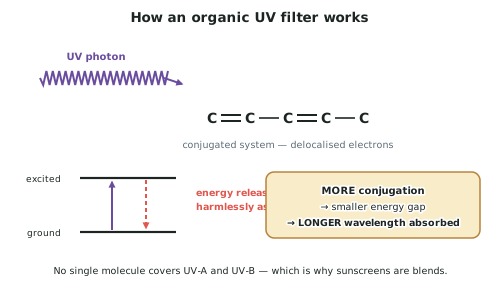
- Organic UV filters are molecules that absorb UV photons and release the energy harmlessly as heat.
- They all share one structural feature: a system of alternating double and single bonds, called conjugation, usually including a benzene ring.
-
Why conjugation matters: in a conjugated system the electrons are delocalised over several atoms rather than held between two. Delocalised electrons are easier to promote to a higher energy level, so the energy gap is smaller — and a smaller gap means the molecule absorbs lower-energy photons.
-
The more extensive the conjugation, the longer the wavelength absorbed. This is the single most useful chemical idea in the whole technology, because it is the dial that formulators turn.
- A short conjugated system absorbs in the UV-B.
- A longer one absorbs in the UV-A.
- Extend it too far and the molecule starts absorbing visible light — it becomes a dye, and is useless as a clear sunscreen.
-
Examples: oxybenzone and octinoxate (UV-B, shorter conjugation), avobenzone (UV-A, longer conjugation).
Inorganic filters — scattering and absorbing
-
Zinc oxide (ZnO) and titanium dioxide (TiO2) are inorganic filters. They are solid particles that sit on the skin surface.
-
They work in two ways at once:
- Scattering — the particles are comparable in size to the wavelength of UV, so they redirect it away from the skin.
- Absorption — both are semiconductors whose electrons absorb UV photons directly.
-
Because they are insoluble solids and are not absorbed through the skin, they cause almost no systemic exposure.
-
The two together cover the whole band: ZnO covers UV-A and UV-B; TiO2 is stronger in the UV-B.
Broad spectrum
- A broad spectrum sunscreen protects against both UV-A and UV-B.
- No single organic filter does this, because a molecule's conjugation length fixes the wavelengths it absorbs. So broad spectrum products are blends, combining a UV-B absorber, a UV-A absorber and often an inorganic filter.
- This is a direct consequence of the chemistry: the reason sunscreen bottles list five or six active ingredients is that one molecule cannot absorb across the full range.
Photostability
-
A filter is only useful if it survives being hit by UV. Some do not.
-
Avobenzone, the main UV-A absorber, degrades under UV — its molecule rearranges into a form that no longer absorbs, so protection falls away during the day.
-
This is fixed chemically, by adding a stabiliser such as octocrylene, which accepts the excess energy from the excited avobenzone molecule before it can rearrange.
-
Photostability is why sunscreen must be reapplied, and why "water resistant for 4 hours" claims exist. The instruction on the bottle is a consequence of molecular behaviour.