The chemistry of the catalytic converter
The problem the technology solves
- A petrol engine burns hydrocarbons in air. If combustion were perfect, the only products would be carbon dioxide and water:
- Combustion is never perfect, and three classes of pollutant come out of the exhaust:
| Pollutant | How it forms | Why it matters |
|---|---|---|
| Carbon monoxide, CO | incomplete combustion where oxygen is limited | binds to haemoglobin far more strongly than O2; toxic |
| Unburnt hydrocarbons | fuel that never burns | contribute to photochemical smog |
| Nitrogen oxides, NO and NO2 | N2 and O2 from the air react at the high temperature in the cylinder | acid rain, smog, respiratory harm |
- Nitrogen oxides are the counter-intuitive one. The nitrogen does not come from the fuel — it comes from the air, and it only reacts because the cylinder is hot enough to overcome the very high activation energy of splitting N2.
What the converter does
- A three-way catalytic converter deals with all three pollutants at once, by carrying out two oxidations and one reduction.
Oxidation of carbon monoxide:
Oxidation of unburnt hydrocarbons:
Reduction of nitrogen oxides:
- The third reaction is elegant: it uses one pollutant to destroy another, converting CO and NO into harmless N2 and CO2 in a single step.
Why a catalyst is needed at all
-
All three reactions are thermodynamically favourable — they release energy and would happen on their own, given enough time.
-
They do not happen fast enough in an exhaust pipe because their activation energies are too high and the gas is in the pipe for a fraction of a second.
-
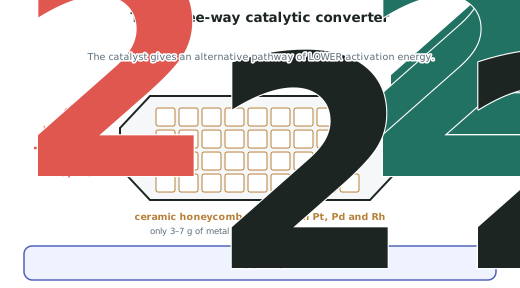
A catalyst provides an alternative reaction pathway with a lower activation energy, so a much greater proportion of collisions has enough energy to react — and the rate increases enormously without the catalyst being used up.
-
This is the AS91166 rates chemistry doing real work: the converter changes nothing about which products are favoured, only about how fast they are reached.
The metals, and why three of them
- The catalysts are platinum (Pt), palladium (Pd) and rhodium (Rh) — all rare, expensive transition metals.
- They are used because each is good at a different job:
- Pt and Pd catalyse the oxidation reactions.
- Rh is the effective catalyst for the reduction of NO to N2.
- This is a heterogeneous catalyst: the metals are solids and the reactants are gases, so the reaction happens on the metal surface.
Surface area and the honeycomb
-
Because the reaction happens on the surface, the surface area determines the rate.
-
The metals are therefore deposited as an extremely thin coating on a ceramic honeycomb, giving an enormous surface area from a few grams of metal.
-
A typical converter contains only around 3–7 g of precious metal in total, spread over a surface area equivalent to several football fields.
-
This is a purely chemical design decision with a large economic consequence: without the honeycomb, the amount of platinum needed would make the technology unaffordable.
Why the engine must run at a precise air–fuel ratio
-
The oxidations need oxygen present; the reduction of NO needs oxygen absent, or the CO will react with O2 instead of with NO.
-
These are contradictory requirements, and a three-way converter only works in a very narrow window around the stoichiometric air-to-fuel ratio, about 14.7 : 1 by mass.
-
Holding an engine in that window requires an oxygen sensor in the exhaust and continuous electronic adjustment of the fuel injection.
-
This is a genuine chemistry-drives-technology link: the modern engine management computer exists in the form it does because the catalytic converter's chemistry will not tolerate being outside that window.
Catalyst poisoning and leaded petrol
-
Lead poisons the catalyst. Tetraethyllead was added to petrol from the 1920s to prevent engine knocking, and lead compounds in the exhaust bind irreversibly to the surface of the platinum, blocking the sites where the reaction occurs.
-
Once the active sites are occupied, the catalyst cannot work, and the effect is permanent.
-
This is why leaded petrol had to be eliminated before catalytic converters could be introduced. In New Zealand, lead was progressively reduced from the 1980s and leaded petrol was withdrawn completely in 1996.
-
Note the direction of causation here: an emissions technology forced the removal of a fuel additive. The chemistry of surface catalysis dictated a change in national fuel policy.