The chemistry of the lithium-ion battery
Why lithium
- A battery converts chemical energy into electrical energy by making a redox reaction happen in two separate places, so the electrons have to travel through a circuit to get from one to the other.
- The useful quantity is energy per unit mass, because a battery that is heavy is a battery you cannot put in a phone or a car.
Three properties of lithium make it the best available choice, and all three are consequences of its position in the periodic table:
-
It is the least dense metal — density 0.53 g cm−3, less than water. Every gram of battery mass that is not lithium is mass that stores no charge.
-
It has the lowest atomic mass of any metal, so one mole of electrons is carried by only 6.9 g of lithium. Sodium needs 23 g for the same job.
-
It loses its outer electron very readily, so it releases a large amount of energy per electron transferred.
-
These are the reasons lithium is used, and they are all chemical reasons — which makes this an unusually clean technology to write about for this standard.
What is inside the cell
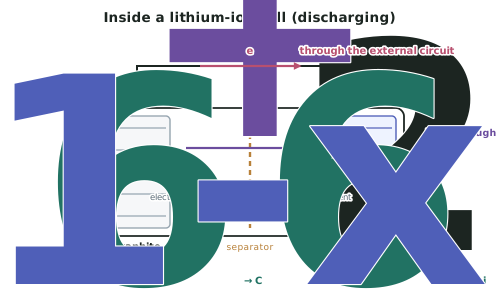
| Component | What it is | What it does |
|---|---|---|
| Positive electrode | a layered metal oxide, typically LiCoO2 | holds lithium ions between its layers |
| Negative electrode | graphite, layers of carbon | holds lithium ions between its layers when charged |
| Electrolyte | a lithium salt in an organic solvent | lets Li+ ions move; must not conduct electrons |
| Separator | a porous polymer film | keeps the electrodes apart while letting ions through |
- The electrolyte is not water. Lithium reacts violently with water, so the solvent is an organic one such as a carbonate ester. This single fact drives much of the safety engineering.
The reactions
On discharge (the battery powering something), lithium ions move from the graphite to the metal oxide, and electrons take the long way round through the circuit:
At the negative electrode (oxidation):
At the positive electrode (reduction):
- The cobalt changes oxidation state as this happens, cycling between +3 and +4. It is the cobalt, not the lithium, that is oxidised and reduced.
- On charging, an external voltage forces both reactions backwards and the lithium ions travel the other way.
Intercalation — the idea that made it work
-
Intercalation means inserting ions between the layers of a solid without breaking the solid apart.
-
Both electrodes are layered materials, and lithium ions slot into the gaps between the layers.
-
This matters enormously, because it means the electrode structure survives being charged and discharged. Nothing dissolves, nothing is deposited as a new solid, and nothing changes shape much.
-
This is why lithium-ion batteries are rechargeable hundreds of times. A battery whose electrodes dissolve and re-form degrades quickly; one where ions simply move in and out of a stable framework does not.
Why not lithium metal
-
The obvious design uses lithium metal as the negative electrode, which stores more energy still. Early rechargeable lithium cells did exactly this, and they were abandoned.
-
On recharging, lithium metal does not plate back evenly. It grows dendrites — thin needle-like spikes — which eventually pierce the separator and short the two electrodes together.
-
A short circuit in a cell containing a flammable organic electrolyte causes rapid heating, and the heat drives further reactions that release more heat: thermal runaway, and fire.
-
Replacing lithium metal with graphite that holds lithium ions solved this. It cost some energy density and bought a battery that does not catch fire when recharged — the central trade-off of the whole technology.