Choosing a technology and structuring the report
Choosing well
A good choice for this standard has all four of these. Check your idea against them before committing.
- The chemistry is Level 2 chemistry. You can explain it with redox, rates, bonding, organic or acid–base ideas you have already been taught.
- There is a real historical arc. Something changed, because of a chemical discovery.
- There are equations to write. If you cannot write a balanced equation about it, the report will struggle to meet EN4.
- There is a trade-off. Something was gained and something was given up — this is where your Excellence evaluation will come from.
| Technology | Chemistry it runs on | The trade-off to evaluate |
|---|---|---|
| Sunscreen | organic structure, conjugation, UV absorption | protection vs cosmetic acceptability vs reef safety |
| Lithium-ion batteries | redox, half equations, ion movement | energy density vs safety vs raw material supply |
| Catalytic converters | rates, catalysis, redox | emissions cut vs precious metal cost vs the leaded petrol problem |
| Stainless steel / alloys | metallic bonding, oxidation, passivation | corrosion resistance vs cost vs recyclability |
| Nylon, polyester, polypropylene | polymerisation, intermolecular forces | durability vs microplastic pollution |
| Aspirin / paracetamol | organic functional groups, esterification | efficacy vs side effects vs manufacturing purity |
| Paint | pigments, polymers, solvents | durability vs VOC emissions vs lead pigments |
| Conducting polymers | conjugation, delocalised electrons | flexibility vs conductivity vs stability |
The report structure
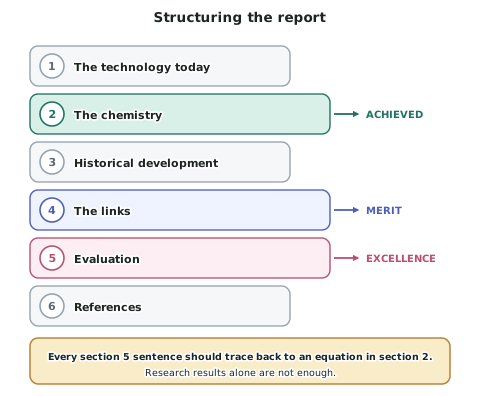
Use these sections. Each one is where a criterion gets met.
- 1. The technology today — what it is, what it does, why it matters. Short.
- 2. The chemistry — the substances, structures, reactions and equations. This is your Achieved section.
- 3. The historical development — the chain of problems and chemical solutions.
- 4. The links — for each stage, how a chemical property caused a design decision. This is your Merit section.
- 5. Evaluation — which chemistry mattered most, what was traded, what the chemistry ruled out. This is your Excellence section.
- 6. References — where your information came from.
Writing section 4 — the links
-
Work stage by stage through the history, not fact by fact.
-
For each stage, write three sentences:
- The problem: what the technology could not do.
- The chemistry: the property, discovery or reaction that addressed it.
- The consequence: what became possible, stated as a design change.
-
Then check: does the middle sentence cause the third? If it merely accompanies it, it is not a link.
Writing section 5 — the evaluation
Three questions, each of which produces evaluation:
-
Which chemical factor was the bottleneck? Usually more than one thing had to be true, and only one of them was actually holding the technology back. Identify which, and justify why the others were not.
-
What was traded away? Every technology gives something up. Name it and quantify it if you can.
-
What did the chemistry make impossible? Constraints are as revealing as enablements. A chemical property that cannot be engineered around fixes the shape of the technology permanently.
-
A fourth question, if it applies: what problem did the solution create? Leaded petrol solved engine knocking and created a lead pollution crisis. That kind of consequence is strong evaluation material.
Referencing
- Use at least three sources, and prefer ones with actual chemistry in them.
- Cite where a specific fact came from, especially dates, quantities and structures.
- Never copy text. Rewrite everything in your own words — this standard is assessed on your reasoning, and copied text demonstrates none of it.