Linear inequations and their regions
From equation to inequation
- An equation such as is satisfied by the points on a line.
- An inequation such as is satisfied by every point on one side of that line, and usually the line itself.
- The solution to an inequation is a region, not a point. That is the whole difference, and it is what makes inequations the right model for "at most", "no more than" and "at least".
The words and the symbols
| Words in the context | Symbol |
|---|---|
| at most, no more than, up to, maximum of, cannot exceed | |
| at least, no fewer than, minimum of, must be | |
| fewer than, under, less than | |
| more than, over, exceeds |
- "At most" and "less than" are different. "At most 20" includes 20; "fewer than 20" does not. The distinction decides whether your boundary line is solid or dashed.
Drawing the region
- Step 1 — Draw the boundary. Replace the inequality sign with and draw that line.
- Find two points, usually the intercepts: set to get the -intercept, set to get the -intercept.
- Step 2 — Choose the line style.
- or → solid line: the boundary is included.
- or → dashed line: the boundary is not included.
- Step 3 — Test a point that is not on the line.
- Use whenever the line does not pass through it — the arithmetic is trivial.
- If the test point satisfies the inequation, shade its side. If not, shade the other side.
- Step 4 — Shade and label. State clearly whether the shading shows the region that satisfies the inequation or the region that is excluded, and keep that convention for every inequation on the diagram.
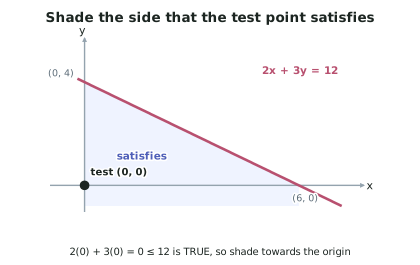
- Testing beats remembering. Rules like " means shade below" fail as soon as the coefficient of is negative. Substituting a point never fails.
Why the sign can flip
- Multiplying or dividing an inequation by a negative number reverses the inequality sign.
- From , dividing by gives .
- This is the single most common algebraic error with inequations.
- Avoid it entirely by not rearranging: leave the inequation as it is, draw the boundary from the intercepts, and test a point.
The non-negativity conditions
- In almost every real context the variables cannot be negative:
- These restrict everything to the first quadrant.
- They are part of the system and must be written down. You cannot make chairs, and a model that allows it is wrong even if the arithmetic that follows is right.
Reading an inequation off a graph
- The reverse task — given a shaded half-plane, state its inequation:
- Find the equation of the boundary line from its intercepts or gradient.
- Decide the direction by testing a point that is clearly inside the shaded area.
- Decide the strictness from the line style: solid → or , dashed → or .
- This is exactly the "connecting representations" EN4 asks for, and it appears in internals as often as the forward direction.
Worked ExampleDrawing a single inequation
A community hall can be hired for events. Each hour of hire costs $40 and each extra staff member costs $60 for the event. The budget is at most $720. Write an inequation, draw its region, and interpret two specific points.
Step 1 — Define the variables
Step 2 — Form the inequation
Total cost is dollars, and the budget cannot be exceeded, so:
"At most" gives , which means the boundary line will be solid.
Step 3 — Simplify before drawing
Every term divides by 20:
Step 4 — Draw the boundary line
Find the intercepts:
- Set : , so . Point .
- Set : , so . Point .
Draw a solid line through and , because the boundary is included.
Step 5 — Test the origin
Substitute into the inequation:
Step 6 — Add the non-negativity conditions
Hours and staff cannot be negative:
The region is therefore the triangle with corners , and .
Step 7 — Interpret two specific points
Point — 12 hours with 4 extra staff:
Point — 15 hours with 3 extra staff:
Step 8 — State what the region means
One practical restriction the graph does not show: only points with whole-number coordinates are usable, since the hall is hired by the hour and staff come as whole people. The region contains infinitely many points, but only the lattice points inside it are real options.