Solving a pair of linear equations
What a pair of simultaneous equations means
- Simultaneous means "at the same time". A solution must satisfy both equations, not one of them.
- One linear equation in two unknowns has infinitely many solutions — every point on its line.
- Two equations pin it down: the solution is where the two lines cross.
- A solution is a pair of values, written as , or as a point . Half an answer is not an answer.
The substitution method
-
Best when one equation already has a variable on its own, or is easy to rearrange.
-
The steps:
- Rearrange one equation to make a variable the subject.
- Substitute that expression into the other equation — never back into the one it came from.
- Solve the resulting equation in one unknown.
- Substitute back to find the second unknown.
- Check in the equation you did not use for the substitution.
-
Worked through — solve and :
- Rearrange the second:
- Substitute:
- Expand:
- Simplify: , so
- Back-substitute:
- Check in the first: ✓
-
Substituting back into the same equation always gives . If that happens, you have used the wrong equation.
The elimination method
-
Best when both equations are in the form .
-
The steps:
- Multiply one or both equations so that the coefficients of one variable match in size.
- Add the equations if those coefficients have opposite signs; subtract if they have the same sign.
- Solve for the remaining variable, then substitute back.
-
Worked through — solve and :
- Multiply the second by 2:
- Subtract from the first: …
Setting that out properly:
- , so
-
Subtracting a negative is where elimination goes wrong. Write the subtraction out in full rather than doing it in your head.
Which method to use
| The system looks like | Use |
|---|---|
| or already isolated | Substitution |
| Both in the form | Elimination |
| One equation is non-linear | Substitution — always |
- The last row is the one that matters for this standard. Elimination cannot handle a squared term, so every non-linear pair is solved by substitution.
The three possible outcomes
- One solution — the lines cross once. Almost every context question is this case.
- No solution — the lines are parallel: same gradient, different intercept. Solving produces a false statement such as .
- Infinitely many solutions — the lines are the same line. Solving produces a true statement such as .
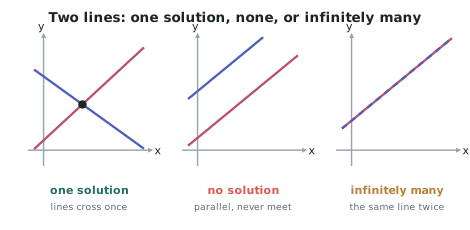
- and look similar and mean opposite things. A true statement means every point on the line works; a false statement means nothing works.
Connecting the representations
- The same system can be shown four ways, and a good answer moves between them:
- In words — "two coffees and three muffins cost $21"
- As equations —
- As a graph — two lines, crossing at the solution
- As a table — pairs of values that satisfy each equation
- The intersection point on the graph and the algebraic solution are the same thing. Saying so explicitly is exactly the "connecting representations" that EN4 asks for.
- Graphs are for showing and checking, algebra is for finding. A reading from a graph is only as accurate as the drawing, so the algebra is the answer and the graph is the evidence.
Worked ExampleForming and solving a linear pair from a context
A school production sells 340 tickets and takes $3,910. Adult tickets are $15 and student tickets are $7. How many of each were sold?
Step 1 — Define the variables in words
This line is not optional. Every equation that follows is meaningless without it.
Step 2 — Form one equation from each piece of information
From the number of tickets:
From the money taken — each adult ticket brings $15 and each student ticket $7:
Step 3 — Choose a method
Equation (1) rearranges in one step, so substitution is quickest:
Step 4 — Substitute into the other equation
Expand:
Collect the terms:
Step 5 — Stop and interpret
This is a genuine part of the answer, not a failure. In a real task you would report the inconsistency; here, suppose the takings were actually $3,900.
Step 6 — Re-solve with the corrected figure
Step 7 — Find the second variable
Step 8 — Check in the equation not used for substitution
Equation (2):
And equation (1): ✓
Step 9 — Answer in context
Both values are whole numbers and both are positive, so the solution makes sense for the situation described.