Systems of inequations and the feasible region
What a system of inequations describes
- Real situations impose several restrictions at once: a budget, a time limit, a minimum order, a storage capacity.
- Each restriction is one inequation, and each inequation cuts the plane down to a half-plane.
- The feasible region is the overlap — the set of points satisfying every inequation simultaneously.
- Every point in the feasible region is a genuinely possible plan. Every point outside breaks at least one restriction.
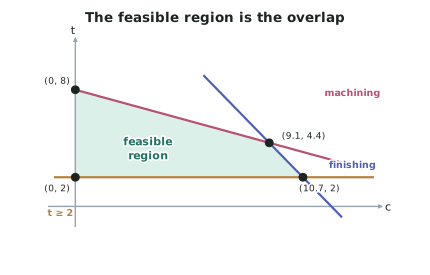
Building the region
- Step 1 — Define the variables, in words, with units.
- Step 2 — Write one inequation per restriction, and add , .
- Step 3 — Draw each boundary line from its intercepts, solid or dashed as required.
- Step 4 — Test the origin in each inequation and mark which side is allowed.
- Step 5 — Identify the overlap and shade it clearly.
- Number your lines on the diagram to match the inequations. A region bounded by five unlabelled lines cannot be checked by anyone, including you.
Finding the corner points
- The corners (vertices) of the region are where two boundary lines cross.
- Find them algebraically, by solving the two boundary equations simultaneously — not by reading the graph.
- Which two lines? Only those that actually meet on the edge of the region. Two boundaries can cross at a point that is outside the region entirely, and that crossing is not a corner.
- Check every candidate corner by substituting it into all the inequations. If it fails one, it is not a corner of the feasible region.
- The corners matter because they are the extreme combinations — the plans that use one or more resources completely.
Bounded and unbounded regions
- A bounded region is enclosed on all sides — it is a polygon with finite area.
- An unbounded region extends forever in some direction. That is normal when all the restrictions are "at least" conditions.
- An unbounded region is not an error, but it is worth saying so, because it means no restriction stops the quantities growing in that direction.
Whole-number solutions
- When the variables count discrete items — trucks, workers, tickets, sacks — only points with whole-number coordinates are usable.
- The corner points are often not whole numbers. A corner at is a genuine corner of the region and an impossible plan.
- List the whole-number points near a corner and test them in every inequation to find the usable options.
- Say this in the write-up. Recognising that the model's continuous region overstates the real set of choices is exactly the interpretation EN4 asks for.
Interpreting the region in context
- A point inside — a plan that satisfies every restriction, with something to spare.
- A point on a boundary — a plan that uses one resource exactly.
- A corner — a plan that uses two resources exactly, at the same time.
- An empty region — the restrictions contradict each other, so no plan is possible at all. Report that as the answer, and say which pair of conditions conflicts.
- Always translate back. "The region has corners at , and " means "the factory can make anything from 0 to 9 of the first product, and the best combinations use both machines fully".
Worked ExamplePlanning a production run
A small workshop makes wooden chairs and tables. Each chair needs 2 hours of machining and 3 hours of finishing. Each table needs 5 hours of machining and 2 hours of finishing. There are at most 40 machining hours and at most 36 finishing hours available this week. The workshop has already promised to deliver at least 2 tables.
Write the system of inequations, draw the feasible region, find its corner points, and interpret the result for the workshop.
Step 1 — Define the variables
Step 2 — Form one inequation per restriction
Machining hours — 2 per chair, 5 per table, at most 40:
Finishing hours — 3 per chair, 2 per table, at most 36:
The promised tables — at least 2:
Non-negativity — you cannot make a negative number of chairs:
Step 3 — Find the intercepts of each boundary
Line (1):
- : →
- : →
Line (2):
- : →
- : →
Line (3): — a horizontal line.
Step 4 — Test the origin in each inequation
- (1): TRUE → shade towards the origin
- (2): TRUE → shade towards the origin
- (3): FALSE → shade away from the origin, above the line
Step 5 — Identify the corner points
The region is bounded below by , on the left by , and above/right by lines (1) and (2).
Corner A — where meets :
Corner B — where meets line (1)? Check both:
- Line (1) at : , so →
- Line (2) at : , so →
Test in inequation (2): FAILS — so is not in the region.
So the corner on is , from line (2).
Corner C — where lines (1) and (2) cross. Solve simultaneously:
Eliminate : gives ; gives . Subtract:
Substitute back into (1):
Check in all inequations: ✓, ✓, and it lies on both (1) and (2) by construction ✓
Corner D — where line (1) meets :
Check in (2): ✓
Step 6 — State the region
Step 7 — Interpret in context, including whole numbers
Two of the corners are not whole numbers, so they are not achievable plans — the workshop cannot make chairs.
Useful whole-number plans near the corners:
- — machining ✓, finishing ✓ Feasible.
- — machining ✓, finishing ✓ Feasible.
- — machining ✓, finishing ✗ Not feasible — 2 hours short on finishing.
The binding restriction depends where you are. Along the edge from to the workshop uses all 36 finishing hours; along the edge from to it uses all 40 machining hours. Only at the corner would both be used completely — and since that point is not a whole number of items, no achievable plan uses both resources exactly.