A line and a curve: non-linear systems
What makes a system non-linear
- A non-linear equation contains a term that is not simply a multiple of or — an , a , an , or a .
- Its graph is a curve, not a line: a parabola, a circle, a hyperbola.
- This standard pairs one non-linear equation with one linear equation — a curve and a straight line.
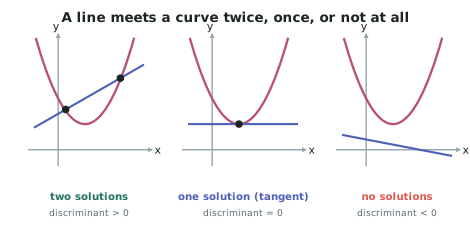
- The solutions are the points where the line meets the curve, and a line can meet a curve twice, once, or not at all.
The method — always substitution
- Elimination cannot work, because adding or subtracting will never cancel a squared term.
- The steps:
- Rearrange the LINEAR equation to make one variable the subject. Always the linear one — rearranging the curve creates square roots.
- Substitute into the non-linear equation.
- Rearrange to the form .
- Solve by factorising, the quadratic formula, or completing the square.
- Find the matching value for each solution by substituting back into the linear equation — it is easier and cannot introduce extra roots.
- Write the solutions as points, and check both in the non-linear equation.
Worked through — a line and a parabola
-
Solve and :
- Both give , so set them equal:
- Rearrange:
- Factorise:
- So or
- From the line, and
- Solutions: and
-
Note the factorising. has a common factor of ; dividing both sides by would lose the solution . Never divide by a variable.
Worked through — a line and a circle
- Solve and :
- Substitute the line into the circle:
- Expand carefully:
- Simplify:
- Divide by 2:
- Factorise: , so or
- From the line: and
- Solutions: and
- is , not . That expansion error is the single most common mistake on this page.
Expecting two answers
- A quadratic normally has two roots, so a non-linear system normally has two solution points.
- Both must be given, each as a complete pair of values.
- Then check both against the context. A negative length or a negative price is rejected — with a stated reason, not silently.
The number of solutions
- After substituting you have a quadratic . The discriminant decides how many times the line meets the curve:
| Discriminant | Roots | Geometry |
|---|---|---|
| Two | The line cuts the curve at two points | |
| One (repeated) | The line is a tangent — it touches at exactly one point | |
| None (real) | The line misses the curve entirely |
- is the tangent condition, and it is how questions about "just touching" are answered without any calculus.
- A repeated root is one point, not two. Saying "two solutions, both the same" describes the algebra but misreads the geometry.
Finding an unknown constant
- A standard question gives a line with an unknown, such as , and asks for the value that makes it a tangent.
- The method:
- Substitute to get a quadratic in whose coefficients contain .
- Set the discriminant to zero and solve for .
- Substitute back to find the point of contact.
- Worked through — for what is a tangent to ?
- , so
- Tangent when : , so
- Then , , and
- The tangent is , touching at
Worked ExampleA rectangular paddock
A rectangular paddock is fenced on all four sides using 60 m of fencing, and encloses an area of 216 m2. Find its dimensions.
Step 1 — Define the variables
Step 2 — Form one equation from each condition
The fencing gives the perimeter:
Divide by 2 immediately — smaller numbers, fewer errors:
The area gives:
Step 3 — Rearrange the LINEAR equation
Step 4 — Substitute into the non-linear equation
Expand:
Step 5 — Rearrange into standard quadratic form
Move everything to one side, keeping the term positive:
Step 6 — Solve the quadratic
Try factorising. We need two numbers multiplying to 216 and adding to 30:
Step 7 — Find the matching for each, from the LINEAR equation
- If :
- If :
Step 8 — Check both in the non-linear equation
- ✓
- ✓
And the perimeter: ✓
Step 9 — Interpret the two solutions in context
The algebra gives two solution points, and — but they describe the same paddock, once with the long side called and once with it called .
Both roots are positive, so neither is rejected; they are simply the same rectangle labelled two ways.
Step 10 — A useful extension check
Would 60 m of fencing enclose an area of, say, 250 m2? The same working gives
No real solutions — it is impossible. The largest area 60 m of fence can enclose is the square case , giving m2, and the discriminant is what detects that limit.