The gradient of a line
The formula
- The gradient measures how steep a line is and which way it slopes:
- Often remembered as — how far up for how far along.
- Each part:
- — the rise, the vertical change
- — the run, the horizontal change
- — the gradient, which may be positive, negative, zero or undefined
Keeping the order consistent
- Unlike the distance formula, the order matters here — but only if you are inconsistent.
- Both differences must be taken in the same direction. Subtracting one way and the other flips the sign.
- Write the two points down and label them before substituting.
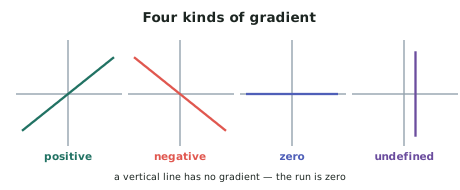
What the value means
-
Positive gradient — the line rises from left to right
-
Negative gradient — the line falls from left to right
-
Zero gradient — the line is horizontal; so the rise is 0
-
Undefined gradient — the line is vertical; so the run is 0 and you cannot divide by zero
-
A steeper line has a larger gradient in magnitude. A gradient of is steeper than one of , even though it is negative.
-
Do not say a vertical line has "zero gradient" or "infinite gradient". The correct statement is that its gradient is undefined.
Working through an example
- The gradient of the line through and :
- With negatives, for and :
- Simplify the fraction, and leave it as a fraction rather than a decimal where it does not terminate neatly.
Collinear points
-
Three or more points are collinear if they all lie on the same straight line.
-
The test: find the gradient between the first pair and between the second pair. If the gradients are equal, the points are collinear.
-
They must share a point. Compare with , so that is common to both — equal gradients then force all three onto one line.
-
Worked through — are , and collinear?
- Equal gradients through the shared point , so , and are collinear ✓
Gradient as a rate of change
- In a context, the gradient is a rate, and its units come from the axes.
- If the horizontal axis is time in hours and the vertical axis is distance in km, the gradient is in km per hour — a speed.
- Interpreting the gradient in context is a Merit-level skill: not just "the gradient is 4", but "the tank is filling at 4 litres per minute".
Worked ExampleTesting for collinearity and interpreting a gradient
(a) Determine whether , and are collinear. (b) A tank's volume litres at time minutes passes through and . Find the gradient and interpret it.
Part (a), Step 1 — Choose which gradients to compare
To test collinearity, compare gradients that share a point. Using as the shared point, we compare and .
Part (a), Step 2 — Find
Taking as point 1 and as point 2:
Note the bracket: , not .
Part (a), Step 3 — Find
Taking as point 1 and as point 2 — the same direction of subtraction:
Part (a), Step 4 — Compare and conclude
The two gradients are equal, and the segments share the point . Two segments with the same gradient through a common point must lie along the same straight line.
Part (b), Step 1 — Identify the variables and their units
- Horizontal axis: time , in minutes
- Vertical axis: volume , in litres
So the gradient will be in litres per minute.
Part (b), Step 2 — Calculate the gradient
Part (b), Step 3 — Interpret in context
The gradient is litres per minute.
- The magnitude, 4, says the volume changes by 4 litres every minute.
- The negative sign says the volume is decreasing.
Part (b), Step 4 — Extend the interpretation
Because the gradient is constant, the rate is steady — the tank drains at the same speed throughout, which is what a straight-line model assumes.
Working backwards, at the volume was 45 L, so at it would have been L, and the tank would be empty when
The model only applies while there is water in the tank — beyond minutes it would predict a negative volume, which is impossible.