Distance between two points
The formula
- The distance between and is:
- Each part:
- — the horizontal separation of the two points
- — the vertical separation
- — the straight-line distance between them, always positive
Where it comes from
- The formula is Pythagoras' theorem in disguise.
- Joining the two points and drawing a horizontal and a vertical line makes a right-angled triangle, with the distance as the hypotenuse.
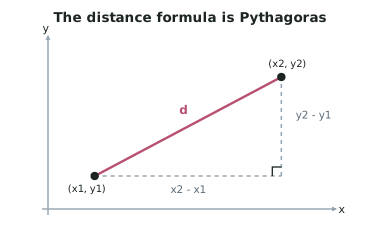
- The horizontal side has length and the vertical side , so:
- Taking the square root gives the formula. Understanding this means you never need to memorise it — you can rebuild it from a sketch.
Why the order does not matter
- is squared, so subtracting the other way round gives the same result:
- You can take either point as "point 1", as long as you are consistent within one calculation.
- The distance is never negative. If your answer is negative, you have taken the square root incorrectly.
Working through an example
-
The distance between and :
- Horizontal difference:
- Vertical difference:
- Apply the formula:
-
Negative coordinates need care. For and :
- Horizontal:
- Vertical:
-
Use brackets when subtracting negatives. , not 1.
Leaving the answer exact
-
Most distances are surds, and the exact form is usually preferred.
-
Simplify by taking out the largest perfect square:
- has no square factor, so it cannot be simplified
-
Give a decimal only if the question asks for one, and round only at the very end.
What distance is used for
-
Showing two sides are equal — an isosceles triangle, a rhombus, a square
-
Showing a point is equidistant from two others
-
Finding a perimeter — add the side lengths
-
Testing for a right angle with the converse of Pythagoras: if , the angle opposite is
-
Note that comparing distances often does not need the square root at all. If you only want to know whether two lengths are equal, comparing values is enough and avoids surds entirely.
Worked ExampleUsing distances to classify a triangle
The points are , and . Show that triangle is isosceles, and determine whether it contains a right angle.
Step 1 — Sketch the points
and both have , so they lie on a horizontal line, 8 units apart. sits above and between them. The triangle looks symmetric — which is worth confirming.
Step 2 — Find
Simplify:
Step 3 — Find
Step 4 — Find
Step 5 — Conclude that the triangle is isosceles
Two sides are equal in length, so triangle is isosceles, with the equal sides meeting at .
Step 6 — Test for a right angle
The longest side is , since . If there is a right angle, it must be opposite the longest side — that is, at .
Apply the converse of Pythagoras. Compare with :
Step 7 — Conclude
Since the sum of the squares of the two shorter sides equals the square of the longest side, the converse of Pythagoras' theorem applies and the angle at is a right angle.
Note how working with made Step 6 trivial — no surds appeared at all, because squaring returns the 32 we already had.