Parallel and perpendicular lines
Parallel lines
- Parallel lines have the same gradient.
-
They point in the same direction, so they never meet, no matter how far they are extended.
-
The -intercepts must differ — if both the gradient and the intercept match, the two equations describe the same line, not a parallel pair.
-
and are parallel. and are the same line.
Perpendicular lines
- Perpendicular lines meet at a right angle, and their gradients multiply to :
- Rearranged, this says:
- The perpendicular gradient is the negative reciprocal — flip the fraction and change the sign. Both steps are needed.
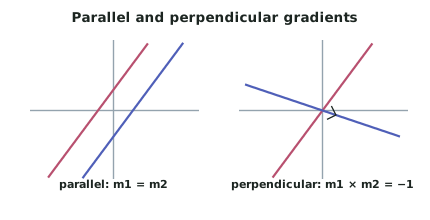
-
Worked examples of the flip:
- → perpendicular gradient
- → perpendicular gradient
- → perpendicular gradient
-
A quick check: the two gradients always have opposite signs, unless one is zero.
The special case
- A horizontal line and a vertical line are perpendicular, but the rule cannot be used — a vertical line has no gradient.
- and meet at a right angle, and you say so directly rather than trying to multiply gradients.
- This is the one case where the formula does not apply, and questions do test it.
Finding a parallel line through a given point
-
Take the gradient from the given line.
-
Use the point-gradient form with the new point.
-
Worked through — the line through parallel to :
- Gradient is 2 (unchanged)
- , so
Finding a perpendicular line through a given point
-
Take the gradient of the given line.
-
Find the negative reciprocal.
-
Use the point-gradient form.
-
Worked through — the line through perpendicular to :
- Original gradient , so the perpendicular gradient is
- , so
-
Rearrange the given line into first if it is in general form. You cannot read the gradient off directly.
The perpendicular bisector
-
The perpendicular bisector of a segment is the line that cuts it in half at right angles.
-
It is the set of all points equidistant from the two endpoints.
-
The method:
- Find the midpoint of the segment — the bisector passes through it.
- Find the gradient of the segment.
- Take the negative reciprocal for the bisector's gradient.
- Use the point-gradient form with the midpoint and the new gradient.
-
Both steps are essential. A line through the midpoint that is not perpendicular is not a perpendicular bisector, and neither is a perpendicular line that misses the midpoint.
Using perpendicularity to prove a right angle
- To show a triangle is right-angled, or a quadrilateral is a rectangle:
- Find the gradients of the two sides meeting at the corner in question.
- Multiply them.
- If the product is , the sides are perpendicular and the angle is .
- State the conclusion, not just the arithmetic: ", so is perpendicular to and the angle at is a right angle."
Worked ExampleFinding a perpendicular bisector
Find the equation of the perpendicular bisector of the segment joining and .
Step 1 — Understand what is needed
A perpendicular bisector must satisfy two conditions:
- it passes through the midpoint of
- it is perpendicular to
Both must be found, and both must be used.
Step 2 — Find the midpoint of
Average each coordinate:
Step 3 — Find the gradient of
Simplify before going further — reduces to .
Step 4 — Find the perpendicular gradient
Flip the fraction and change the sign:
Check: ✓ and the two gradients have opposite signs ✓
Step 5 — Build the equation
Use the point-gradient form with the midpoint and the perpendicular gradient :
Step 6 — Rearrange
Step 7 — Check both defining properties
Does it pass through the midpoint?
Is it perpendicular to ?
Step 8 — Confirm with the equidistance property
Every point on a perpendicular bisector is equidistant from the two endpoints. Testing the point , which lies on the bisector since :
Equal distances, confirming the line is genuinely the perpendicular bisector.