Size, scope and timeframe
The definition this standard is built on
- The standard is not about external factors. It is about the business's strategic response to them — and "strategic" has a precise meaning here.
- A strategic response is a business-wide reaction, at multiple levels, which differs in:
- size — how much of the business's resources it commits
- scope — how much of the business it reaches: the whole business, a global or regional market, all departments, or a single department
- timeframe — short, medium or long term
- The 2026 assessment specifications state this definition, and the 2025 exam tested it directly: candidates had to state the strategic response and explain why it is a business-wide reaction at multiple levels, using at least TWO of size, scope and timeframe.
- So the very first thing to learn in this standard is how to prove a response is strategic. Every question in this topic starts there.
Strategic versus operational
| Operational response | Strategic response | |
|---|---|---|
| Who decides | A supervisor or department manager | Senior management or the board |
| Size | Small — within an existing budget | Large — significant resources committed |
| Scope | One team, one task | Multiple departments, or a whole market |
| Timeframe | Days to weeks | Months to years |
| Reversibility | Easy to undo | Hard and costly to undo |
| Example | Adding an extra delivery run this week | Relocating the distribution centre to a different country |
- Both are legitimate responses. The standard only credits the strategic one, so if the response you describe could be authorised by a shift supervisor, choose a different one.
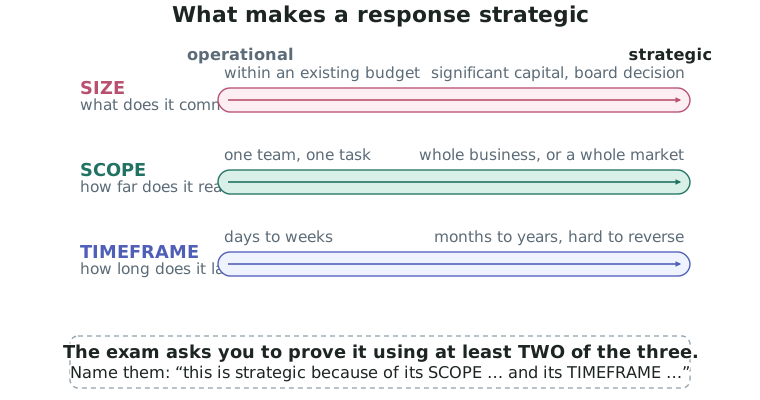
How to prove a response is strategic
- Take the response and run it through the three tests. You only need two of them, but say which two you are using.
- Size. What does it commit?
- "The cultural intelligence training programme requires a dedicated budget, external facilitators and paid time off the floor for every employee, so it needs a decision at senior management level rather than departmental approval."
- Scope. How far does it reach?
- "It reaches every department, not only the sales team who deal with overseas customers, because production, despatch and accounts all correspond with the host-country business."
- Timeframe. How long does it run and how long do its effects last?
- "It is delivered over an eighteen-month cycle and its effects — how staff behave with suppliers and customers — persist for years after the training itself finishes."
What a strategic response actually looks like
- Responses that qualify, in each of the content areas of this standard:
- Sustainability — a zero-waste programme, converting the vehicle fleet, redesigning packaging across the whole range, a supplier code of conduct.
- Cultural intelligence — a cultural training programme for all staff, hiring in-market staff, appointing an in-country agent, redesigning products for a market's cultural expectations.
- Assistance — engaging an export development agency, joining a formal mentoring or export programme, entering a joint venture with a local partner.
- Multinational activity — establishing a subsidiary offshore, licensing the brand to a local manufacturer, withdrawing from a market.
- Marketplace change — diversifying into new markets to reduce dependence on one, holding higher inventory to absorb supply disruption, moving to direct online sales.
The four-part shape of these questions
- The strategic-response parts of the exam run to four sub-parts, and each has its own job:
- (i) state the response and prove it is strategic — size, scope, timeframe
- (ii) ONE positive impact — explain, then carry it to a business goal
- (iii) ONE negative impact — there is always a cost, and it is usually money, time, or attention taken from something else
- (iv) a justified conclusion on the likely success of the response, including new information
- Plan all four before writing, and keep one point back for (iv). If your best idea is used in (ii), the conclusion has nothing new to say.