The impact of multinationals on the host country
What "host country" means
- The host country is the country a multinational operates in, as distinct from its home country where it is owned and headquartered.
- New Zealand is a host country for many multinationals, and New Zealand businesses that expand offshore become multinationals in someone else's host country. The analysis works both ways.
- The teaching guide lists this as its own content area, and the exam expects both sides of it.
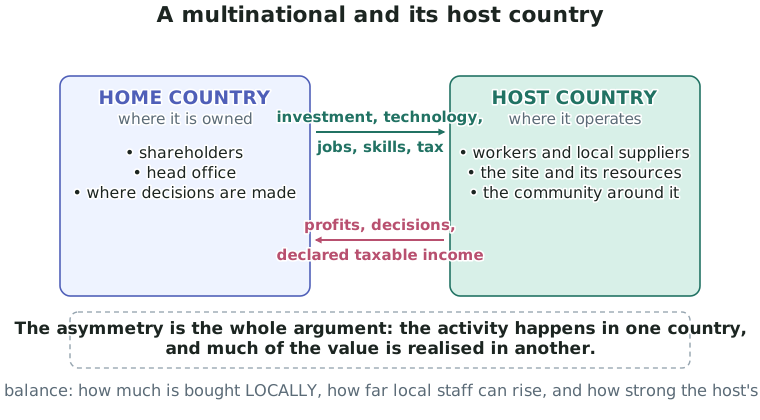
- The asymmetry in that picture is the whole argument. The activity — the work, the resource use, the effect on a community — happens in the host country. A large share of the value, and all the decisions about it, end up somewhere else.
Positive impacts on a host country
- Employment. Jobs created directly, and more in the local businesses that supply the operation.
- Investment. Capital that the host economy did not have to raise, spent on plant, buildings and infrastructure.
- Skills and technology transfer. Local staff are trained in methods and equipment that then spread through the economy when they move jobs.
- Local supply chains. Local suppliers gain a large, stable customer and often have to raise their standards to keep it, which makes them better suppliers to everyone.
- Tax revenue from company tax, employment taxes and consumption taxes.
- Exports and foreign exchange, where the operation produces for export.
- Consumer benefit. More choice, sometimes lower prices, and access to products the local market could not produce.
- Standards. Multinationals often bring employment, safety and environmental practices above the local minimum.
Negative impacts on a host country
- Profits leave. The returns flow to shareholders in the home country rather than staying in the host economy.
- Local businesses are displaced. Smaller domestic competitors lose market share and close, and the jobs created may be fewer than the jobs lost.
- Weak bargaining position. A large employer can press for tax concessions, weaker regulation or subsidies, because it can credibly move elsewhere.
- Decisions are made offshore. A plant can be closed by a decision taken in another country for reasons that have nothing to do with its local performance.
- Environmental cost. Where regulation is weaker, production may impose costs the host country bears.
- Working conditions. Wages and conditions may be low by the home country's standards even when legal locally.
- Cultural impact. Global brands and formats can displace local products, practices and, in some cases, language.
- Resource extraction. Where the operation depends on land, water, minerals or fisheries, the resource is consumed locally and the value realised elsewhere — the point at which kaitiakitanga and rangatiratanga become directly relevant.
- Transfer pricing. Multinationals can arrange prices between their own subsidiaries so profit is declared in low-tax countries, reducing the tax the host country collects.
How the balance actually falls
- It is genuinely a balance, and the exam rewards saying what it depends on:
- What the operation does. A research and development centre transfers far more skill than a warehouse.
- How much is sourced locally. An operation buying from local suppliers spreads far more benefit than one importing everything.
- Whether local staff reach senior roles, or all decisions and career paths run through the home country.
- How strong the host country's regulation is. Where labour and environmental rules are enforced, the negatives shrink.
- How dependent the host region becomes. A town with one large employer is exposed to a decision it cannot influence.