Standing waves in strings and pipes
Key ideas
- A standing wave forms when a wave and its reflection superpose. The pattern stays in place: some points never move, others swing with maximum amplitude.
- Node — a point of zero amplitude (the two waves always cancel there).
- Antinode — a point of maximum amplitude (the two waves always reinforce there).
- Adjacent nodes are half a wavelength apart: node-to-node distance .
- A string or pipe only sustains the standing waves that fit its length. These allowed patterns are the harmonics, and each has its own natural frequency.
- Resonance is what happens when the system is driven at one of those natural frequencies — energy is fed in step with the oscillation and a large-amplitude standing wave builds up.
- Throughout, connect frequency and wavelength with , where is the wave speed in the string or the speed of sound in the pipe.
Strings (fixed at both ends)
- Both ends must be nodes.
- The fundamental (1st harmonic) fits half a wavelength: , so .
- Every whole-number multiple fits: for — all harmonics are present.
Pipes
- An open end is an antinode (air free to move); a closed end is a node (air can't move).
- Open pipe (open both ends) — antinode at each end:
- , , and all harmonics occur ().
- Closed pipe (one end closed) — node at the closed end, antinode at the open end:
- only a quarter wavelength fits: ,
- only odd harmonics occur:
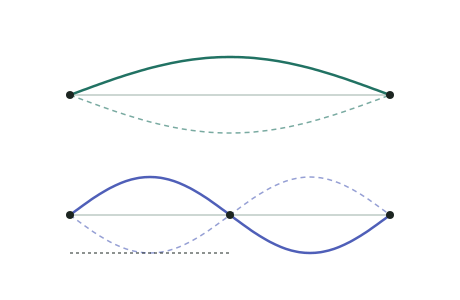
A guitar string is m long, and waves travel along it at m s⁻¹. Find the fundamental frequency and the frequency of the 3rd harmonic.
Step 1 — Fundamental wavelength (both ends are nodes)
Half a wavelength fits the string, so
Step 2 — Fundamental frequency from
Step 3 — Strings carry every harmonic
Tips
- Closed pipes have no even harmonics. If your working produces for a closed pipe, you have made a mistake — check which end is a node.
- The fundamental of a closed pipe is an octave below an open pipe of the same length ( vs ) — a favourite compare-and-explain question.
Test yourself
Practice by grade
One question each at Achieved, Merit and Excellence. Have a go, then compare with the model answer.
Achieved
A string fixed at both ends is m long.
Show that the wavelength of its fundamental is m.
Merit
A closed pipe (one end closed) is m long. The speed of sound is m s⁻¹.
Calculate the fundamental frequency, and state which harmonic comes next.
Excellence
An open pipe and a closed pipe have the same length.
Compare their fundamental frequencies and their harmonic series, explaining the differences using nodes and antinodes.