Two-slit interference
Key ideas
- When light (or sound) passes through two narrow slits, each slit acts as a source, and the two sets of waves superpose on the far side.
- What each point on a screen receives depends on the path difference — how much further the wave from one slit travelled than from the other:
- path difference → waves arrive in phase → constructive → a bright fringe (or loud point)
- path difference → arrive out of phase → destructive → a dark fringe (quiet point)
- The bright fringes ("orders") sit at angles given by:
- Each variable, with sub-bullets:
- — the slit separation (m)
- — the angle from the straight-through direction to the th bright fringe
- — the order: (centre),
- — the wavelength (m)
- On a screen a distance away, with fringe spacing , the small-angle version applies:
- valid because is metres while is fractions of a millimetre, so
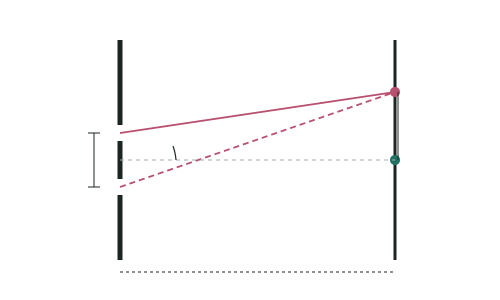
Laser light through slits mm apart makes fringes mm apart on a screen m away. Find the wavelength.
Step 1 — Adjacent bright fringes differ by one order ()
Use the small-angle relationship with the fringe spacing:
Step 2 — Convert to SI units first
m, m, m.
Step 3 — Substitute
Tips
- Say what the path difference is, not just the formula. Merit/Excellence explanations need "the wave from the lower slit travels one whole wavelength further, so crests still meet crests" — not just .
- Moving the screen further away () or using longer wavelength () spreads the fringes; wider slit spacing () squeezes them. Check your answer moves the right way.
Test yourself
Practice by grade
One question each at Achieved, Merit and Excellence. Have a go, then compare with the model answer.
Achieved
In a two-slit experiment, the path difference to a point on the screen is exactly .
State what is observed at that point, and why.
Merit
Light of wavelength nm passes through slits mm apart onto a screen m away.
Calculate the fringe spacing.
Excellence
In a two-slit experiment with red light, the apparatus is changed in two ways: the red source is swapped for a blue one, and the slits are moved closer together.
Explain what each change does to the fringe pattern.