The Doppler effect
Key ideas
- The Doppler effect is the change in the frequency you hear when a source of waves moves relative to you.
- At Level 3 the standard covers a moving source and a stationary observer (for mechanical waves such as sound). A moving observer is not in the standard.
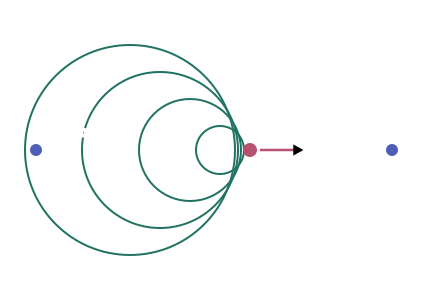
- The physics: a moving source chases its own wavefronts.
- Ahead of the source, wavefronts are squashed together — shorter wavelength — so a stationary listener hears a higher frequency.
- Behind, they are stretched apart — longer wavelength — a lower frequency.
- The observed frequency is:
- Each variable, with sub-bullets:
- — the frequency the source actually emits (Hz)
- — the frequency the stationary observer hears (Hz)
- — the speed of the waves (e.g. sound, m s⁻¹ in air)
- — the speed of the source (m s⁻¹)
- Choosing the sign: the source approaching squeezes the waves, so the denominator must shrink — use minus. Receding stretches them — use plus. Check the answer moved the right way rather than memorising the sign.
An ambulance siren emits Hz. The ambulance travels at m s⁻¹ and the speed of sound is m s⁻¹. Find the frequency heard by a stationary pedestrian as it approaches, and after it passes.
Step 1 — Approaching: wavefronts squashed, so the denominator shrinks (minus)
Step 2 — Receding: wavefronts stretched (plus)
Step 3 — Sanity check
Higher while approaching, lower after passing — the familiar nee-naw drop as it goes by.
Tips
- Reason the sign, then check the direction of your answer. Approaching must give ; receding must give . If your numbers go the other way, the sign is wrong — fix it before moving on.
- The change is not symmetric: the rise while approaching ( Hz above) is bigger than the drop after passing ( Hz), because sits in the denominator. Don't average them and expect .
Test yourself
Practice by grade
One question each at Achieved, Merit and Excellence. Have a go, then compare with the model answer.
A train sounding its Hz horn approaches a stationary observer at m s⁻¹. The speed of sound is m s⁻¹.
Show that the observer hears about Hz.
A car horn emits Hz. A stationary listener hears Hz. The speed of sound is m s⁻¹.
Calculate the car's speed and state whether it is approaching or receding.
Explain, in terms of wavefronts, why a stationary observer ahead of a moving sound source hears a higher frequency — and why the frequency the source emits is unchanged.